
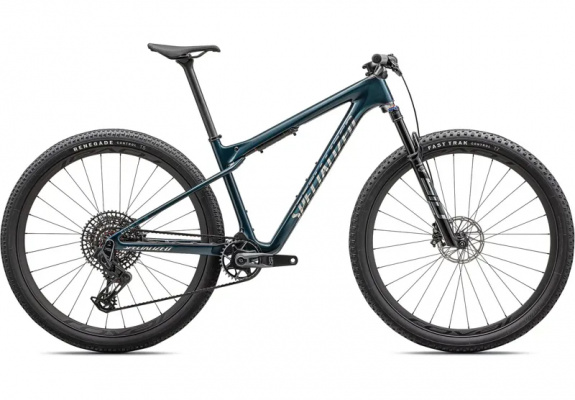
Specialized Epic World Cup Pro
Race-tuned XC weapon that climbs like a hardtail, descends with full-suspension poise, and rewards smooth aggression with addictive speed.
- WCID suspension: 75mm travel, hardtail efficiency with full-sus control
- Brain fork auto-adjusts without lockout faff
- FACT 11m carbon frame weighs just 1,765g with shock
- SRAM X0 Eagle Transmission: wireless shifting, integrated power meter
- Roval Control carbon wheels: 29mm internal, DT Swiss 350 hubs
- Progressive XC geometry: 66.5° head angle, composed descending
Specialized Epic World Cup Pro Deals

Prices and availability can change quickly. Delivery charges are not always included in listed prices.
Final price, stock status and delivery terms are set by retailer. We may receive a commission on purchases made.
Bikesy's Verdict
The Epic World Cup Pro is a bike that demands commitment. It's light, stiff, and efficient enough to rival a hardtail on climbs, yet it offers the traction and control of full suspension when the trail gets technical. The WCID suspension and Brain fork work brilliantly together, delivering a ride that feels taut and responsive under power but adapts seamlessly when the ground gets rough, all without requiring you to touch a lockout lever or think about suspension settings. It's a clever, well-executed system that makes the bike faster and more intuitive to ride.
Progressive XC geometry brings confidence and composure that traditional XC bikes lack, so you can push harder on descents and carry more speed through rough sections without the bike feeling nervous or deflecting off line. The component spec is race-ready, with SRAM X0 Transmission, an integrated power meter, and Roval carbon wheels that keep weight low and performance high. It's a bike built for riders who race the clock, whether that's on a World Cup start line or your local loop, and it rewards smooth, aggressive riding with a responsiveness that's addictive.
The trade-off is comfort. The firm suspension tune and limited travel mean you'll feel more of the trail than you would on a plush trail bike, and the lack of a dropper post limits descending versatility. If you're not racing or riding at race pace, there are more forgiving, versatile options available. But if you want the fastest, most efficient XC race bike you can buy without stepping up to an S-Works build, the Epic World Cup Pro is hard to beat. It's a machine that blurs the line between hardtail and full suspension, and it does so with precision, purpose, and undeniable speed.
Pros
- Exceptionally light at 10.36kg, climbs like a hardtail with full-suspension traction
- WCID suspension and Brain fork deliver efficiency without manual lockout faff
- SRAM X0 Transmission with integrated Quarq power meter: race-ready, wireless, data-driven
- Progressive XC geometry: confident descending, precise handling, stable at speed
- Roval Control carbon wheels and cockpit keep weight low, stiffness high
Cons
- Firm suspension tune feels harsh if you prioritise comfort over race pace
- Limited 75mm rear travel won't suit long, rough descents or big-hit terrain
- No dropper post as stock; fixed seatpost limits descending versatility
About the Specialized Epic World Cup Pro
The Epic World Cup Pro sits at the sharp end of Specialized's XC race stable, a bike designed to blur the line between hardtail snap and full-suspension composure. Built around the WCID suspension platform - a co-developed RockShox system that tucks 75mm of travel into the top tube - it delivers the pedalling efficiency you'd expect from a rigid rear end but adds a layer of traction and control that keeps you glued to the ground when the trail gets choppy. Pair that with the Brain fork up front, which uses an inertia valve to distinguish your pedal strokes from trail chatter, and you've got a bike that thinks for itself while you focus on the next apex.
At 10.36 kilograms without pedals, the Pro model leans heavily on its FACT 11m carbon frame and Roval Control carbon cockpit to shed grams without sacrificing stiffness. The SRAM X0 Eagle Transmission drivetrain brings wireless shifting and an integrated Quarq power meter, so you can chase watts as precisely as you chase lines. It's a machine built for riders who race the clock, whether that's on a World Cup start line or your local loop, and it rewards smooth, aggressive riding with a responsiveness that feels closer to a hardtail than any 75mm-travel bike has a right to.
This isn't a bike that coddles you. The WCID shock runs best with minimal sag - often near topped-out - and the Brain fork's firm platform means you'll feel more of the trail than you would on a plush trail bike. But that's the point. You get immediate feedback, instant power transfer, and a front end that stays high in its travel when you're hammering out of corners or sprinting for a gap. If your weekends revolve around XC race courses, fast singletrack, or any scenario where seconds matter more than comfort, the Epic World Cup Pro makes a compelling case for ditching the hardtail altogether.
Specialized Epic World Cup Pro geometry
Specialized's Progressive XC Race Geometry pushes the Epic World Cup Pro into more confident territory than traditional XC bikes. The 66.5-degree head angle is slack enough to inspire trust on technical descents, yet the bike retains the quick steering you need to thread tight singletrack at speed. Reach sits at 440mm in medium, placing you in a forward, aggressive posture that loads the front wheel without feeling cramped when the trail tilts up. The longer front centre keeps the bike stable at speed, so you're not constantly wrestling the bars when the ground gets rough.
Rider-First Engineered tuning means each frame size gets its own carbon layup and tube shaping, so a small frame doesn't feel flexy and an extra-large doesn't feel like a barge. The result is consistent handling across the size range, with stiffness where you need it - bottom bracket, head tube, chainstays - and compliance where it helps, particularly in the seatstays. When you're out of the saddle on a punchy climb, the bike feels taut and responsive; when you sit back and let the suspension work, it tracks predictably without wandering or feeling vague.
The shorter 75mm rear travel and relatively steep seat angle keep your weight centred over the pedals, so you're not fighting the bike to stay balanced on technical climbs. Because the shock is integrated into the top tube, the centre of gravity drops lower than a conventional layout, which translates to a more planted feel through fast corners and a less top-heavy sensation when you're picking your way through rock gardens. It's a geometry that prioritises efficiency and precision, but it doesn't punish you when the trail gets rowdy.
Component choices & upgrades
The stock build on the Epic World Cup Pro is already race-ready. SRAM's X0 Eagle Transmission delivers crisp, reliable shifts without cables to fray or housing to clog, and the integrated Quarq power meter means you've got training data baked in. The 10-52-tooth cassette offers enough range for steep XC climbs without resorting to a granny gear that you'll never use on race day. The RockShox SID SL Ultimate Brain fork and SIDLuxe WCID shock are tuned specifically for this frame, so swapping them out would likely cost you the unique ride character that defines the bike.
Roval Control carbon wheels - 29mm internal width, DT Swiss 350 hubs - are light, stiff, and hookless, which keeps tyre retention secure at lower pressures. The Specialized Fast Trak front and Renegade rear tyres are fast-rolling and predictable, though you might want to experiment with tread patterns if your local trails skew muddy or loose. The SRAM Level Silver brakes are adequate for XC racing, but if you're heavier, ride steep terrain regularly, or simply want more power and modulation, upgrading to SRAM Code or Shimano XT four-piston callipers would be a sensible move without adding much weight.
The S-Works Carbon XC Mini Rise bar is wide enough (760mm) for control but narrow enough to slip through tight trees, and the Roval Control SL carbon seatpost keeps weight low while offering enough compliance to take the sting out of repeated hits. Specialized doesn't spec a dropper post, which is typical for pure XC race bikes, but if you're riding varied terrain or want more descending confidence, a short-travel dropper like the RockShox Reverb AXS or OneUp V3 (80 - 100mm travel) would integrate cleanly without compromising the bike's race intent. Just remember: every upgrade should serve a purpose. The stock build is already dialled for speed, so only change components if your riding demands it, not because you're chasing marginal gains on paper.
Where the Specialized Epic World Cup Pro excels
This bike is built for XC racing and fast, technical singletrack where efficiency and responsiveness matter more than plush travel or all-day comfort. If you're lining up for a cross-country race, chasing Strava segments, or riding loops where climbs are frequent and descents are short and punchy, the Epic World Cup Pro is in its element. The WCID suspension and Brain fork work together to keep the bike taut and efficient under power, so you're not wasting energy bobbing through travel, yet they provide enough traction and control to keep you on the gas when the trail gets rough.
It's also a strong choice for riders who want the benefits of full suspension without the weight penalty or sluggish feel of a traditional trail bike. The 75mm rear travel and 110mm fork offer more capability than a hardtail, especially on choppy climbs and fast, rooty descents, but the bike retains that immediate, connected feel that makes hardtails so rewarding to ride. When the trail is smooth and you're sprinting out of corners, it feels like a rigid bike; when the ground gets technical, the suspension wakes up just enough to keep your tyres planted and your speed high.
Where it's not ideal: long, rough descents with sustained chatter, big hits, or steep, loose terrain. The limited travel and firm suspension tune mean you'll feel more of the trail than you would on a 120mm trail bike, and the lack of a dropper post (as stock) limits your ability to shift your weight back on steep descents. It's also not the bike for riders who prioritise comfort over speed, or who want a forgiving, easy-going ride. The Epic World Cup Pro demands smooth, aggressive riding and rewards it with speed and precision. If you're not racing or riding at race pace, there are more versatile, comfortable options in Specialized's range - like the Epic Evo - that offer more travel and a more forgiving ride character.
Specialized Epic World Cup Pro FAQs
What is the weight of the Specialized Epic World Cup Pro?
Approximately 10.36 kilograms without pedals, with tubes fitted. The FACT 11m carbon frame alone weighs 1,765 grams painted, with shock and hardware, making it one of the lightest full-suspension XC frames available.
What is the travel on the Specialized Epic World Cup Pro?
The rear shock offers 75mm of travel via the WCID suspension system, while the RockShox SID SL Ultimate Brain fork provides 110mm up front. Both are tuned to run firm and efficient, prioritising pedalling performance over plush bump absorption.
Is the Specialized Epic World Cup Pro a good bike for racing?
Absolutely. It's designed specifically for XC racing, with a lightweight frame, efficient suspension, and race-ready components including SRAM X0 Eagle Transmission and an integrated power meter. The geometry and suspension tune reward smooth, aggressive riding at race pace.
What is the difference between the Specialized Epic World Cup and the Epic Evo?
The Epic Evo offers more suspension travel - 110mm rear, 130mm front - and a more trail-oriented geometry, making it more versatile and forgiving on rough terrain. The Epic World Cup prioritises race performance, with less travel, a lighter frame, and a firmer suspension tune focused on efficiency and speed.
Does the Specialized Epic World Cup Pro come with a dropper post?
No, the stock build uses a fixed Roval Control SL carbon seatpost. This is typical for pure XC race bikes, where weight savings and pedalling efficiency are prioritised over descending versatility. A short-travel dropper can be retrofitted if you want more descending confidence.
What is the WCID suspension on the Specialized Epic World Cup?
WCID (World Cup Integrated Design) is a co-developed suspension system with RockShox that integrates the shock into the frame's top tube. It uses independently adjustable positive and negative air springs and is designed to run with minimal sag, delivering hardtail-like efficiency with added traction and control on rough terrain.
How does the Brain fork on the Specialized Epic World Cup Pro work?
The Brain damper uses an inertia valve to automatically distinguish between rider input (pedalling, sprinting) and trail input (bumps, roots). It stays firm under pedalling forces to prevent bobbing, then opens up when it detects trail impacts, providing active suspension without requiring manual lockout adjustments or remote levers.
What are the key technologies in the Specialized Epic World Cup Pro?
WCID suspension, Brain fork technology, Rider-First Engineered carbon layup, FACT 11m carbon frame, and Progressive XC Race Geometry. These combine to deliver a bike that's light, stiff, efficient, and capable, with suspension that adapts automatically to terrain without rider intervention.
Is the Specialized Epic World Cup Pro suitable for trail riding?
It can handle fast, technical singletrack and moderate trail riding, especially if you're comfortable on a firm, responsive bike. However, the limited travel and firm suspension tune mean it's not ideal for long, rough descents, big hits, or all-day comfort. For more versatile trail riding, the Epic Evo is a better choice.
Key Features & Benefits
- WCID suspension with 75mm travel: Hardtail efficiency on climbs, full-suspension traction on rough ground, without the weight or bob of traditional designs
- RockShox SID SL Ultimate Brain fork: Automatically firms up under pedalling, opens for bumps - no lockout lever needed, so you stay focused on the trail
- FACT 11m carbon frame (1,765g with shock): Featherweight and stiff, accelerates instantly and climbs with minimal effort, yet handles aggressive riding without flex
- SRAM X0 Eagle Transmission with Quarq power meter: Wireless shifting, robust drivetrain, and integrated power data for training and racing without extra hardware
- Progressive XC Race Geometry (66.5° head angle, 440mm reach): Confident, stable descending and precise handling, with an aggressive posture that keeps weight centred for efficient climbing
Specialized Epic World Cup Pro 2024 & 2023 differences
The 2025 model refines the component spec with SRAM X0 Eagle Transmission as standard across most Pro builds, replacing the XO AXS Transmission found on 2024 models. DT Swiss 350 hubs are now specified on the Roval Control wheels, offering robust engagement and serviceability. Suspension tuning has been subtly refined, though the core WCID rear shock and Brain fork technology remain unchanged. Frame weight is cited as 1,765 grams (painted, with shock and hardware) for 2025, compared to 1,915 grams for some 2024 models, suggesting minor layup optimisations or measurement differences.
The 2024 model featured SRAM XO AXS Transmission, RockShox SID SL Ultimate Brain fork (110mm), and the same RockShox-Specialized SIDLuxe WCID Ultimate shock (75mm). Roval Control carbon wheels with 29mm internal width, S-Works Carbon XC Mini Rise handlebars (760mm), and the Body Geometry Power Expert saddle were carried over. The 2023 model shared the same core design and technologies, with some builds speccing SRAM XX SL Transmission and a frame weight of 1,765 grams. Across all three years, the fundamental ride character - efficient, responsive, and race-focused - remains consistent, with incremental improvements to components and tuning rather than wholesale redesigns.
Alternatives to Consider
Within Specialized's own range, the Epic Evo offers 110mm rear and 130mm front travel, making it more forgiving and versatile on rough trails while sacrificing some of the World Cup Pro's race-focused efficiency. If you want even less weight and the purest XC race machine, the S-Works Epic World Cup steps up to FACT 12m carbon, XX SL Transmission, and a sub-10kg build, though at a significantly higher price. For riders who prefer the simplicity and snap of a hardtail, Specialized's Epic Hardtail Pro strips away rear suspension entirely, saving weight and offering an even more direct ride feel.
Cross-brand, the Scott Spark RC 900 Pro is a direct rival, with TwinLoc remote suspension control, similar travel, and a reputation for efficient climbing and composed descending. The Trek Top Fuel 9.7 offers 115mm rear travel and a more trail-friendly character, making it slightly more versatile if you mix XC racing with rougher riding. Cannondale's Scalpel Carbon 2 uses the Lefty Ocho fork and FlexPivot rear end for a unique ride feel that's both efficient and playful, though the proprietary fork limits upgrade paths. For riders who want a bit more travel without losing XC speed, the Santa Cruz Blur XX1 AXS RSV pairs 115mm rear travel with a lower-link VPP design that's supple yet efficient, and the Orbea Oiz M10 offers a similar blend of race performance and trail capability with a clean, integrated aesthetic.
Reviews
Lightweight carbon and a suspension system that refuses to bob make this bike feel faster than anything else on the climbs. The WCID rear end stays taut under power, so every pedal stroke translates directly into forward motion, yet when the trail gets choppy the shock wakes up just enough to keep the rear tyre planted. Brain technology up front means the fork stays firm when you're sprinting out of corners, then opens seamlessly when roots or rocks appear, all without touching a lever. It's a clever system that works, and once you trust it you stop thinking about suspension altogether and just ride.
Descending reveals the benefits of Progressive XC Race Geometry. The 66.5-degree head angle and longer front centre bring composure that traditional XC bikes lack, so you can push harder into rough sections without the front wheel deflecting or the bike feeling nervous. When you're threading tight singletrack at speed, the bike responds instantly to bar inputs, yet it doesn't feel twitchy or unstable. Because the shock is integrated into the top tube, the centre of gravity sits lower, which translates to a more planted feel through fast corners and less of that top-heavy sensation you get on bikes with conventional shock mounts.
Firm suspension tuning won't suit everyone. The WCID shock is designed to run with minimal sag, often near topped-out, and the Brain fork's platform is noticeably stiffer than a traditional XC fork with a lockout lever. You feel more of the trail, which is great for feedback and control but less forgiving if you're not riding smoothly or if the terrain gets properly rough. On long, sustained descents with repeated hits, the limited 75mm rear travel and firm tune mean you're working harder to stay composed than you would on a 120mm trail bike. It's a trade-off: you gain efficiency and responsiveness, but you sacrifice some comfort and capability on the roughest terrain.
Component spec is race-ready. SRAM X0 Eagle Transmission shifts crisply and reliably, the integrated Quarq power meter delivers accurate data without extra hardware, and the Roval Control carbon wheels are light, stiff, and spin up quickly. SRAM Level Silver brakes are adequate for XC racing, though riders who descend aggressively or ride steep terrain might want more power. The absence of a dropper post is typical for a pure XC race bike, but it does limit your ability to shift weight back on steep descents, and retrofitting a short-travel dropper would add versatility without compromising the bike's race intent. Overall, this is a machine that rewards smooth, aggressive riding with speed and precision, and it's one of the most capable XC race bikes available if you're willing to meet it on its terms.
Full Specification
| Spec | Value |
|---|---|
| Frame Material | FACT 11m Carbon |
| Frame Design | WCID suspension design with Progressive XC Race Geometry |
| Frame Features | Internal cable routing, SWAT EMT Cage-Mount Tool, integrated shock within top tube, provisions for two water bottle cages |
| Tyre Clearance | 2.4 inches |
| Bottom Bracket | Threaded BSA |
| Rear Axle | 12x148mm Boost, UDH compatible |
| Fork | RockShox SID SL Ultimate Brain |
| Fork Travel | 110mm |
| Fork Offset | 44mm |
| Fork Adjustments | Top-adjust Brain damper, DebonAir, Position-Sensitive technology |
| Rear Shock | RockShox-Specialized SIDLuxe WCID Ultimate |
| Rear Travel | 75mm |
| Rear Shock Adjustments | Independent positive and negative air springs, adjustable rebound |
| Drivetrain | 1x12 speed |
| Shifters | SRAM POD AXS controller |
| Rear Derailleur | SRAM XO Eagle Transmission |
| Crankset | SRAM XO DUB with 34T X-Sync chainring, Quarq Power Meter integrated |
| Bottom Bracket Standard | SRAM DUB Threaded Wide |
| Cassette | SRAM XS 1295, 10-52T |
| Chain | SRAM XO Eagle |
| Brakes | Hydraulic Disc |
| Brake Levers | SRAM Level Silver |
| Brake Calipers | SRAM Level Silver, 2-piston |
| Rotors (Front) | 180mm |
| Rotors (Rear) | 160mm |
| Rims (IW) | Roval Control, carbon offset design, 29mm internal width, hookless |
| Hubs (Front) | DT Swiss 350, straight-pull, 15x110mm |
| Hubs (Rear) | DT Swiss 350, straight-pull, 12x148mm Boost, DT Swiss Ratchet driver |
| Spokes | DT Swiss Competition Race, straight-pull |
| Tyres (Front) | Specialized Fast Trak, Control Casing, T7 Compound, 29x2.35 |
| Tyres (Rear) | Specialized Renegade, Control Casing, T5 Compound, 29x2.35 |
| Handlebar | S-Works Carbon XC Mini Rise, 760mm wide, 6-degree upsweep, 8-degree backsweep, 10mm rise |
| Stem | Specialized Pro SL, alloy, 4-bolt, 70mm length |
| Grips | Specialized Trail Grips |
| Seatpost | Roval Control SL carbon, 30.9mm diameter, 0mm offset |
| Saddle | Body Geometry Power Expert |
| Weight (Approx) | 10.36 kg (22.84 lb) without pedals, with tubes |