
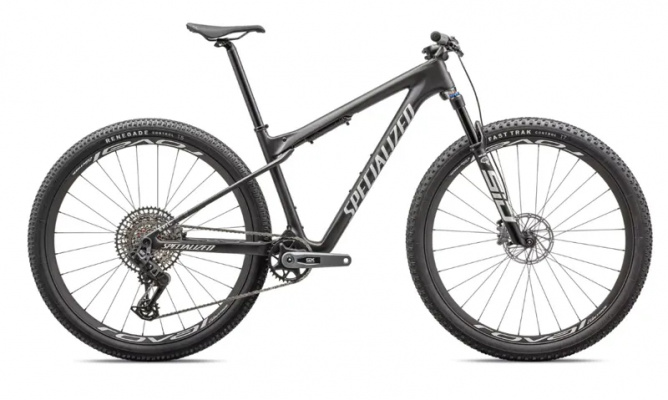
Specialized Epic World Cup Expert
Race-bred XC speed with hardtail snap and full-suspension calm for smooth to technical courses.
- WCID shock hidden in top tube: hardtail snap, full-suspension calm
- BRAIN fork damping: no remote levers, instant response to terrain
- SRAM GX AXS wireless shifting: clean cockpit, precise changes
- Roval Control carbon wheels: 29mm internal, stiff and light
- 110mm fork, 75mm rear: race-bred travel for XC courses
- 10.5 kg frame-up: climbs like a hardtail, descends with composure
Specialized Epic World Cup Expert Deals

Prices and availability can change quickly. Delivery charges are not always included in listed prices.
Final price, stock status and delivery terms are set by retailer. We may receive a commission on purchases made.
Bikesy's Verdict
The Specialized Epic World Cup Expert is a race bike in the truest sense: light, efficient, and utterly focused on speed. It pedals like a hardtail, descends with full-suspension composure, and rewards smooth, precise riding with blistering pace. The WCID shock and BRAIN fork deliver intuitive, lever-free suspension control, while the FACT 11m carbon frame and Roval wheels keep weight low and stiffness high.
It's not a do-it-all trail bike. Seventy-five millimetres of rear travel is enough for most XC courses, but it'll feel harsh if you're charging through rock gardens or dropping off ledges. The SRAM Level Bronze brakes are functional but not exceptional, and the race-focused geometry won't suit riders seeking all-day comfort. But if you're chasing podiums, racing marathons, or simply want the fastest bike for smooth to moderately technical terrain, the Epic World Cup Expert is a brilliant, single-minded tool. It's a bike that demands skill and rewards commitment - and if that's what you're after, you'll love every pedal stroke.
Pros
- Hardtail-like pedalling efficiency with full-suspension composure
- BRAIN fork and WCID shock: no remote levers, intuitive response
- Lightweight FACT 11m carbon frame accelerates and climbs with ease
- Modern XC geometry: stable on descents, efficient on climbs
- Roval Control carbon wheels: stiff, light, and race-ready
Cons
- Seventy-five millimetres of rear travel feels limited on rough, technical descents
- SRAM Level Bronze brakes lack the power and modulation of higher-tier options if you're racing steep terrain
- Race-focused geometry and firm suspension won't suit riders seeking all-day trail comfort
About the Specialized Epic World Cup Expert
The Epic World Cup Expert is Specialized's sharpest tool for cross-country racing - a bike that pedals with the snap of a hardtail yet offers the composure of full suspension when the course gets rough. Built around the WCID (World Cup Integrated Design) suspension platform, it tucks the shock inside the top tube, lowering the centre of gravity and freeing the cockpit from remote levers. The result? A machine that feels intuitive, looks clean, and rewards every watt you put through the cranks.
Underneath the FACT 11m carbon frame sits seventy-five millimetres of rear travel paired with a hundred and ten up front - numbers that might seem modest until you realise they're tuned for efficiency, not plushness. The RockShox SIDLuxe WCID shock features independently adjustable positive and negative air springs, so you can dial in anything from a firm, race-ready platform to a more forgiving setup for technical sections. Meanwhile, the SID SL Select+ fork incorporates BRAIN technology - a position-sensitive damper that opens on impact and firms up under pedalling load, all without you touching a lever. It's suspension that thinks for itself, leaving you to focus on the line ahead.
This isn't a bike for everyone. It's built for riders who chase podiums, who know that a lighter, stiffer frame translates to faster splits, and who understand that seventy-five millimetres of travel is plenty when the course is smooth to moderately technical. If your weekends involve long fire-road climbs, tight singletrack switchbacks, and the occasional rock garden, the Epic World Cup Expert will feel like an extension of your legs. If you're hunting for a mini-enduro rig or a bike to smash gnarly descents, you'll want more travel and a slacker head angle.
Specialized Epic World Cup Expert geometry
Specialized's Rider-First Engineered approach means each frame size is proportioned to deliver consistent handling, whether you're on an XS or an XL. The geometry is progressive by XC standards - longer reach figures than older race bikes, a head angle that's calm enough to inspire confidence on descents, and a seat angle that plants you over the bottom bracket for efficient climbing. You'll sit upright enough to breathe deeply on long ascents, yet low enough to weight the front wheel when the trail pitches down.
The longer front centre and moderate wheelbase strike a balance between stability and agility. On tight, twisty singletrack, the bike pivots quickly; on faster, open sections, it holds a line without feeling twitchy. The bottom bracket sits low enough to keep your weight centred, but not so low that you're clipping rocks on every root section. It's a geometry that rewards smooth, efficient riding - think flowing arcs rather than aggressive, late-braking dives.
Because the shock is integrated into the top tube, the standover height is lower than you'd expect, making it easier to move your weight back on steep descents or tight corners. The shorter chainstays (for an XC bike) help the rear wheel track predictably, and the overall package feels planted without sacrificing the nimbleness you need to thread through technical sections at race pace.
Component choices & upgrades
The stock build is already well sorted. SRAM's GX AXS Transmission brings wireless shifting and a wide-range twelve-speed cassette (ten to fifty-two teeth) that covers everything from punchy climbs to flat-out sprints. The thirty-four-tooth chainring up front is a sensible middle ground for most XC courses. The DT Swiss 350 hubs laced to Roval Control carbon rims are light, stiff, and reliable - exactly what you want when you're chasing seconds. Specialized's own Fast Trak and Renegade tyres offer predictable grip and low rolling resistance, though you might swap them for something with more bite if your local trails are loose or muddy.
The SRAM Level Bronze brakes are functional but not exceptional. If you're a heavier rider or you're racing in steep, technical terrain, upgrading to SRAM Code or Shimano XT four-piston callipers will give you more power and better modulation. The alloy seatpost does the job, but if you're keen to shed a few grams or add a dropper for more technical courses, a carbon post or a short-travel dropper (if your racing allows it) will broaden the bike's versatility.
The alloy handlebar and stem are sturdy and well-proportioned, but riders chasing every gram might consider a carbon bar or a lighter stem. That said, the stock cockpit is stiff enough for hard efforts and wide enough (750 millimetres) to give you control on descents. Unless you're racing at the sharp end or you've outgrown the stock kit, there's little reason to change much - this build is already dialled for its intended purpose.
Where the Specialized Epic World Cup Expert excels
This bike is outstanding on cross-country race courses: smooth to moderately technical singletrack, long climbs, and fast, flowing descents. It accelerates like a hardtail, holds speed effortlessly, and rewards smooth, efficient pedalling. If you're racing World Cup circuits, short track, or marathon events, the Epic World Cup Expert will feel like a natural extension of your fitness and skill.
It also handles fast trail riding well - think flowing singletrack, fire roads, and less aggressive descents where you're prioritising speed over plushness. The BRAIN fork and WCID shock smooth out roots and small rocks without bobbing under power, so you can maintain momentum through technical sections. The low weight and stiff frame make it a joy to climb, and the modern geometry keeps it composed when the trail points downwards.
Where it's not ideal: rough, rocky descents with big hits, steep chutes, or aggressive trail riding that demands more travel and a slacker head angle. Seventy-five millimetres of rear travel is enough for most XC courses, but it'll feel harsh if you're charging through rock gardens or dropping off ledges. Riders who want a do-it-all trail bike or a mini-enduro rig will find the Epic World Cup Expert too focused, too firm, and too race-oriented. It's a scalpel, not a sledgehammer.
Specialized Epic World Cup Expert FAQs
What is the travel on the Specialized Epic World Cup Expert?
The fork offers a hundred and ten millimetres of travel, while the rear shock provides seventy-five millimetres. It's a race-bred setup designed for efficiency and control on XC courses, not for smashing through rough, technical descents.
Is the Specialized Epic World Cup Expert a good bike for trail riding?
It's capable on fast, flowing trails and less technical descents, but it's not built for aggressive trail riding. If your trails are smooth to moderately rough and you prioritise speed over plushness, it'll work well. For rockier, steeper terrain, you'll want more travel.
What is the weight of the Specialized Epic World Cup Expert?
A medium frame weighs around 10.5 kilograms without pedals. That's light enough to accelerate quickly and climb efficiently, though the S-Works version shaves off another kilogram if you're chasing every gram.
How does the WCID shock work on the Specialized Epic World Cup?
The WCID shock is integrated into the top tube and features independently adjustable positive and negative air springs. You can tune it from firm (hardtail-like) to more plush, depending on the course and your preference. It's designed to be ridden with minimal sag for maximum efficiency.
Can I fit a dropper post on the Specialized Epic World Cup Expert?
The frame uses a standard 30.9-millimetre seatpost, so a short-travel dropper will fit if your racing allows it. That said, most XC racers stick with a fixed post to save weight and maximise pedalling efficiency.
What are the main differences between the Epic World Cup and the regular Epic?
The Epic World Cup has less travel (seventy-five millimetres rear versus a hundred and twenty on the Epic 8), a more race-focused geometry, and the WCID integrated shock design. The regular Epic is more versatile and capable on technical trails, while the World Cup is sharper and more efficient for racing.
Is the BRAIN technology still relevant on the Epic World Cup fork?
Absolutely. The BRAIN damper opens on impact and firms up under pedalling load without any input from you, so you get small-bump compliance and a firm platform without cluttering the cockpit with remote levers. It's intuitive and effective, especially on varied XC courses.
What kind of rider is the Specialized Epic World Cup Expert best suited for?
Competitive XC racers and fast trail riders who value efficiency, low weight, and precise handling. If you're chasing podiums, racing marathons, or simply want the fastest bike for smooth to moderately technical terrain, this is your machine. If you're after all-day comfort or aggressive trail capability, look elsewhere.
Key Features & Benefits
- WCID integrated shock with adjustable air springs: Hardtail snap when you're pedalling, full-suspension calm when the trail gets rough - tune it to match the course
- BRAIN position-sensitive fork damping: Opens on impact, firms up under power - no remote levers, no fuss, just intuitive response to terrain
- FACT 11m carbon frame with Rider-First Engineered sizing: Stiff, light, and proportioned for consistent handling across every frame size
- SRAM GX AXS wireless twelve-speed drivetrain: Clean cockpit, precise shifts, and a wide-range cassette that covers steep climbs and flat-out sprints
- Roval Control carbon wheels with DT Swiss 350 hubs: Low weight, high stiffness, and reliable engagement for race-day confidence
Specialized Epic World Cup Expert 2025 & 2024 differences
The 2025 and 2024 models are virtually identical in specification and design. Both feature the SRAM GX AXS Transmission drivetrain, RockShox SID SL Select+ fork with BRAIN technology, and the RockShox-Specialized SIDLuxe WCID Ultimate rear shock. Frame weight is listed as 1,915 grams (painted, with shock and hardware) for both years, and the FACT 11m carbon construction remains unchanged.
The 2026 model continues with the same core platform, suggesting Specialized is confident in the WCID suspension design and the overall package. Component updates are minimal year-on-year, with the focus remaining on race-day efficiency, low weight, and intuitive suspension control. If you're considering a 2024 or 2025 model, you're getting the same ride character and performance as the 2026 - any differences will be down to availability and condition rather than meaningful spec changes.
Alternatives to Consider
Within Specialized's own range, the Specialized Epic 8 Expert offers more travel (a hundred and twenty millimetres front and rear) and a more versatile, trail-focused character if you want XC efficiency with broader capability. Step down to the Specialized Epic 8 Comp for a similar ride feel with a more accessible spec - mechanical shifting and alloy wheels - while stepping up to the Specialized S-Works Epic World Cup brings electronic shifting, lighter carbon wheels, and a frame that sheds another kilogram.
Cross-brand, the Scott Spark RC 900 Comp is a direct rival, blending integrated suspension with efficient pedalling and a similar race-bred focus. The Orbea Oiz M30 offers comparable XC performance with a slightly more forgiving ride character, while the Trek Supercaliber 9.7 leans even harder into the hardtail-with-suspension concept, trading a bit of descending composure for outright climbing speed. For riders who want a touch more capability without losing race pace, the Santa Cruz Blur CC X01 AXS RSV brings a hundred and fifteen millimetres of travel and a more playful, trail-ready attitude, though it's heavier and less single-minded than the Epic World Cup.
Reviews
Longer reach and a calmer front centre bring poise without sacrificing the quick, darting agility XC courses demand. The WCID shock delivers a firm, race-ready platform that mimics a hardtail's snap, yet it opens up enough to smooth out roots and small rocks when the trail gets technical. Pedalling efficiency is exceptional - there's no bob, no wasted energy, just direct power transfer that rewards smooth cadence and clean lines.
BRAIN technology in the fork feels intuitive. It opens on impact, firms up under load, and does it all without you touching a lever. Small-bump compliance is surprisingly good for a race bike, though the seventy-five millimetres of rear travel can feel choppy on rougher descents if you're not riding smoothly. When the course is smooth to moderately technical, the bike carves through corners and holds speed effortlessly. Push it into rockier, more aggressive terrain and you'll feel every hit - this isn't a bike that forgives sloppy lines or heavy landings.
The SRAM GX AXS drivetrain shifts crisply and the wireless setup keeps the cockpit clean, though the Level Bronze brakes feel adequate rather than confidence-inspiring. Modulation is decent, but power could be stronger if you're racing steep, technical descents. The Roval Control wheels are stiff and light, and the Fast Trak and Renegade tyres offer predictable grip and low rolling resistance, though you might want something with more bite if your local trails are loose or muddy.
Climbing is where this bike truly shines. It accelerates out of corners, holds momentum on long fire-road grinds, and rewards every watt you put through the pedals. Descending is composed and precise, provided you're on the right terrain. It's a scalpel, not a sledgehammer - brilliant on XC race courses, less forgiving when the trail gets rough.
Full Specification
| Frame Material | FACT 11m Carbon |
| Fork | RockShox SID SL Select+, 110mm travel, 3-position damper with BRAIN technology |
| Rear Shock | RockShox-Specialized SIDLuxe WCID Ultimate, 75mm travel |
| Shifters | SRAM AXS POD Controller / SRAM XS-1275, 12-speed |
| Rear Derailleur | SRAM GX AXS Transmission |
| Crankset | SRAM GX Eagle, DUB, 165mm (XS, S), 170mm (M), 175mm (L, XL), 34T chainring |
| Cassette | SRAM XS 1275, 12-speed, 10-52t |
| Chain | SRAM GX Transmission / SRAM GX Eagle |
| Brakes | SRAM Level Bronze, 4-piston caliper, 180mm front / 160mm rear rotors |
| Rims | Roval Control, Carbon offset design, 29mm internal width |
| Hubs | DT Swiss 350, 6-bolt, 15x110mm front, 12x148mm rear (XD freehub body) |
| Spokes | DT Swiss Competition Race Straight-pull |
| Front Tyre | Specialized Fast Trak, Control Casing, T7 Compound, 29x2.35 |
| Rear Tyre | Specialized Renegade, Control Casing, T5 Compound, 29x2.35 |
| Handlebar | Specialized Alloy Minirise, 10mm rise, 750mm width, 31.8mm clamp |
| Stem | Specialized XC, 3D-forged alloy, 4-bolt, 6-degree rise |
| Grips | SRAM Slip on with Twist-Loc |
| Seatpost | Specialized Alloy, Single Bolt, 30.9mm |
| Saddle | Body Geometry Power Sport, steel rails |
| Bottom Bracket | SRAM DUB Threaded Wide |
| Rear Axle | 12x148mm UDH compatible |
| Tyre Clearance | 29x2.35" |
| Weight (Size M) | 10.5kg |