
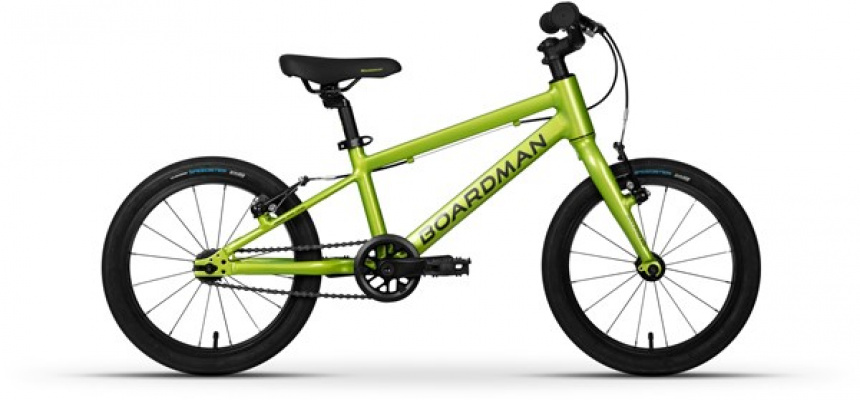
Boardman JNR 16
Light, simple, and confidence-building - perfect for five-to-seven-year-olds making the leap from balance bike to pedalling.
- Lightweight triple-butted alloy frame: easier to balance and steer
- Single-speed drivetrain: simple to learn, low maintenance
- Short-reach brake levers: designed for small hands
- One-piece bar and stem: familiar feel from balance bikes
- Weighs just 6.2 kg: manageable for young riders
- Smooth welds: clean finish and comfortable ride
Boardman JNR 16 Deals

Prices and availability can change quickly. Delivery charges are not always included in listed prices.
Final price, stock status and delivery terms are set by retailer. We may receive a commission on purchases made.
Bikesy's Verdict
The Boardman JNR 16 does exactly what it sets out to do: it makes learning to pedal straightforward, confidence-building, and fun. The lightweight frame, single-speed drivetrain, and short-reach brake levers remove the friction from those first few months on two wheels, and the one-piece bar and stem setup feels immediately familiar to balance-bike graduates. It's a bike that doesn't overwhelm, doesn't fight back, and doesn't demand constant maintenance.
If your child is aged five to seven, has an inside leg of 48 to 53 centimetres, and is ready to move beyond scooting, the JNR 16 is a smart, well-executed choice. It's light enough to handle, simple enough to master, and tough enough to survive the inevitable bumps and scrapes. You're not buying a bike they'll outgrow in a month - you're buying a tool that'll help them become a rider.
Pros
- Lightweight 6.2 kg frame makes balancing and steering easy for young riders
- Single-speed drivetrain keeps things simple and low-maintenance
- Short-reach brake levers designed for small hands offer confident stopping
- One-piece bar and stem setup feels familiar for balance-bike graduates
- Smooth welds and clean finish give it a quality look
Cons
- Single speed limits progression if your child's ready for hillier terrain or faster riding
- Rigid fork and 16-inch wheels mean rough trails will feel harsher than on larger bikes
- Limited tyre clearance if you want to fit knobbier rubber for off-road adventures
About the Boardman JNR 16
The Boardman JNR 16 is built around a simple truth: when you're five years old and learning to pedal for the first time, the last thing you need is a bike that fights back. This is a machine that weighs just over six kilos, wears a single-speed drivetrain, and borrows its one-piece bar-and-stem setup straight from the balance bike your child's just graduated from. It's a deliberate, thoughtful design that prioritises confidence over complexity, and it works.
Boardman drew inspiration from their adult HYB hybrid range when shaping the JNR 16, which means you get smooth welds, a clean silhouette, and a frame that doesn't look like a toy. The triple-butted alloy construction keeps weight down without sacrificing durability - important when you're dealing with kerb hops, playground shortcuts, and the occasional tumble. This isn't a bike that'll hold your child back as their skills develop, but it won't overwhelm them on day one either.
What makes the JNR 16 particularly effective is how it removes friction from the learning process. No gears to fumble with, no complicated cockpit, just pedals, brakes, and momentum. The Tektro V-brakes wear short-reach levers that small hands can actually squeeze with authority, and the 16-inch Vee Speedster tyres offer enough cushion and grip for pavements, park paths, and the odd grassy shortcut. It's a bike that lets kids focus on riding, not wrestling with equipment.
Boardman JNR 16 geometry
Boardman hasn't published detailed geometry charts for the JNR 16 - reach, stack, and head angle figures aren't part of the conversation here - but the bike's proportions are guided by a clear sizing window. It's designed for children with an inside leg measurement of 48 to 53 centimetres, typically aged five to seven, and standing between 112 and 126 centimetres tall. Those numbers translate to a riding position that's upright and confidence-inspiring, with the bars close enough that your child isn't stretching to steer.
The one-piece bar and stem setup mimics the geometry of a balance bike, which means the transition feels intuitive rather than jarring. The bars sit 460 millimetres wide - narrow enough that young riders can turn without oversteering, but broad enough to offer leverage when they need it. The rigid alloy fork with its chromo steerer keeps the front end predictable, and the 16-inch wheels strike a balance between manoeuvrability and stability. You won't find slack angles or long wheelbases here; this is a bike that responds quickly, turns tightly, and rewards the kind of instinctive steering that kids excel at.
The upright posture also means your child can see what's ahead without craning their neck, and the low standover height makes mounting and dismounting straightforward. When you're building confidence, being able to get a foot down quickly matters more than any number on a geometry chart.
Component choices & upgrades
The stock build on the JNR 16 is already well-sorted for its intended audience. The Tektro J310 mini V-brakes paired with JL350 short-reach levers offer reliable stopping power without demanding a death grip, and the single-speed drivetrain - anchored by a Prowheel crankset with 102-millimetre arms and a 25-tooth chainring - keeps things mechanically simple. The KMC chain is robust, the 14-tooth rear sprocket provides a sensible gear ratio for flat to gently rolling terrain, and the double chainguard protects fingers and trouser legs alike.
The Vee Speedster tyres are a solid all-rounder for tarmac and hard-packed paths, and the double-wall alloy rims can handle the inevitable bumps and scrapes. The Boardman-branded saddle and grips are comfortable enough for short rides, and the 25.4-millimetre alloy seatpost offers plenty of adjustment as your child grows.
Upgrades aren't really necessary unless your child's riding outpaces the bike's intended scope. If they're spending more time on rougher trails, a set of knobbier tyres might add grip, though you'll be limited by the clearance of the frame and fork. If the saddle becomes uncomfortable on longer rides, a replacement with a bit more padding is an easy swap. Beyond that, the JNR 16 is best left as it is - this is a bike designed to be ridden, not tinkered with. Save the upgrade budget for the next size up.
Where the Boardman JNR 16 excels
The JNR 16 is outstanding at one thing above all: helping young riders make the leap from balance bike to pedal bike with minimal fuss. It's light enough that a five-year-old can pick it up, steer it confidently, and stop it without drama. The single-speed drivetrain removes the cognitive load of gear selection, letting kids focus on pedalling rhythm and balance. The short-reach brake levers mean they can actually modulate their speed rather than just hoping for the best.
It's also excellent for pavements, park paths, and light trails - the kind of riding that defines a child's first few years on two wheels. The Vee Speedster tyres grip well on tarmac and hard-packed dirt, and the rigid fork keeps the front end predictable. The bike's low weight and responsive handling make it fun to ride, which is the most important metric of all at this age.
What it's not ideal for is anything beyond gentle off-road exploration. The 16-inch wheels and rigid fork mean rough trails will rattle your child more than they need to, and the single-speed gearing will run out of legs on anything resembling a proper climb. If your child is already confident on varied terrain and ready for gears, they've probably outgrown this bike. But for the target audience - kids aged five to seven who are learning to pedal and building confidence - the JNR 16 hits the mark squarely.
Boardman JNR 16 FAQs
What is the best age for a 16-inch bike?
A 16-inch bike typically suits children aged five to seven years, though inside leg measurement is a more reliable guide than age. The JNR 16 is designed for riders with an inside leg of 48 to 53 centimetres, which usually corresponds to that age range. If your child can comfortably straddle the bike with both feet flat on the ground, they're ready.
How much does the Boardman JNR 16 weigh?
The JNR 16 weighs approximately 6.2 kilograms. That's light enough for a young child to manoeuvre confidently, and it makes a noticeable difference when they're learning to balance and steer. A lighter bike is easier to control, and that translates directly into confidence.
Is a single-speed bike good for a child?
Yes, particularly for beginners. A single-speed drivetrain removes the complexity of gear shifting, letting your child focus on pedalling, steering, and braking. It's also mechanically simpler, which means less maintenance and fewer things to go wrong. Once they've mastered the basics, they can move to a geared bike.
What is the ideal inside leg measurement for a 16-inch bike?
The JNR 16 is designed for an inside leg measurement of 48 to 53 centimetres. Measure from the ground to your child's crotch while they're standing in socks, and make sure they can straddle the bike with both feet flat. A proper fit is more important than matching an age guideline.
What are the benefits of short-reach brake levers for kids' bikes?
Short-reach brake levers are designed to fit smaller hands, which means your child can actually squeeze them with enough force to stop effectively. Standard levers are too far from the bars for young riders, which compromises control and confidence. The Tektro JL350 levers on the JNR 16 are purpose-built for this, and they make a real difference.
How do I maintain a single-speed kids' bike?
Maintenance is straightforward. Keep the chain clean and lightly lubricated, check the brake pads for wear, and make sure the tyres are inflated to the recommended pressure. Tighten any loose bolts, and occasionally check that the wheels are true. Because there's no derailleur or cassette to adjust, a single-speed bike is one of the easiest to keep running smoothly.
What are good alternatives to the Boardman JNR 16?
The Frog 44, Woom 3, and Isla CNOC 16 are all strong competitors in the 16-inch category. Each offers a lightweight frame, child-specific components, and a focus on ease of use. The Frog 44 is slightly lighter, the Woom 3 has a particularly refined geometry, and the Isla CNOC 16 is known for its durability. All three are excellent choices if you're comparing options.
Key Features & Benefits
- Lightweight triple-butted alloy frame: Easier for young riders to lift, balance, and steer, building confidence from the first ride
- Single-speed drivetrain with 25-tooth chainring: Removes the complexity of gear shifting, letting kids focus on pedalling and braking
- Tektro short-reach brake levers: Designed for small hands, offering reliable stopping power without requiring a tight grip
- One-piece bar and stem setup: Mimics balance bike geometry, making the transition to pedalling feel natural and intuitive
- Vee Speedster 16-inch tyres on double-wall rims: Provide grip and cushioning on pavements and park paths, with durability for everyday use
Boardman JNR 16 2025 and 2024 differences
The Boardman JNR range was relaunched in late 2022, and the core design of the JNR 16 has remained consistent through 2024, 2025, and into 2026. The triple-butted alloy frame, single-speed drivetrain, Tektro V-brakes with short-reach levers, and Vee Speedster tyres have carried over across all three model years without significant changes. The focus has been on refinement rather than redesign, which makes sense for a bike aimed at young children - the fundamentals work, and Boardman hasn't felt the need to tinker.
Any differences between the 2024, 2025, and 2026 models are likely to be minor, such as updated decals, slight colour variations, or component batch changes that don't affect performance. The geometry, weight, and component spec have remained stable, so if you're choosing between model years, you're essentially getting the same bike. The 2026 model continues the same philosophy: lightweight, simple, and built to help kids learn to pedal with confidence.
Alternatives to Consider
Within the Boardman JNR range, the Boardman JNR 12 is the natural step-down for younger siblings still on a balance bike, while the Boardman JNR 20 is the next size up for riders who've outgrown 16-inch wheels and are ready for gears. The JNR 20 introduces a multi-speed drivetrain and larger wheels, making it better suited to longer rides and more varied terrain.
Cross-brand, the Frog 44 is a direct competitor that's slightly lighter and offers a similarly refined geometry, with a focus on ease of use and quality components. The Woom 3 is another strong contender, known for its low weight and carefully considered proportions - it's a favourite among parents who prioritise handling precision. The Isla CNOC 16 is built with durability in mind and features a slightly more robust frame, making it a good choice if your child's riding is already leaning towards rougher terrain. The Ridgeback Dimension 16 offers a more budget-conscious option with a heavier frame but solid components, while the Hoy Bonaly 16 sits somewhere in the middle, balancing weight and price with a focus on British design. Each of these bikes shares the JNR 16's philosophy of making the transition to pedalling as smooth as possible, but they differ in weight, geometry refinement, and component spec.
Reviews
Lightweight construction changes everything for a five-year-old learning to pedal. At 6.2 kilograms, the JNR 16 doesn't fight back when your child tries to steer, and that translates directly into confidence. The single-speed drivetrain keeps the learning curve gentle - no fumbling with shifters, no chain drops, just pedal and go. When you're building muscle memory for balance and braking, simplicity is a feature, not a compromise.
Tektro's short-reach brake levers are a standout detail. Small hands can actually squeeze them with enough force to stop effectively, which matters more than any other component on a kids' bike. We've seen too many children struggle with standard levers that sit too far from the bars, and the JL350s solve that problem cleanly. The V-brakes themselves offer predictable, progressive stopping power - no drama, no surprises.
Handling is intuitive. The one-piece bar and stem setup mimics the geometry of a balance bike, so the transition feels natural rather than jarring. The 16-inch wheels turn quickly without feeling twitchy, and the rigid fork keeps the front end predictable on pavements and park paths. Vee Speedster tyres grip well on tarmac and hard-packed dirt, though they'll struggle if your child ventures onto loose gravel or mud. That's fine - this bike isn't built for trail riding, and it doesn't pretend to be.
Because the frame is light and the gearing is fixed, kids can focus on rhythm and balance without worrying about mechanical complexity. The double chainguard protects fingers and trouser legs, and the smooth welds give the bike a quality finish that doesn't look like a toy. It's a bike that encourages independence, and that's worth more than any spec sheet can quantify.
Full Specification
| Spec | Value |
|---|---|
| Frame Material | Lightweight triple-butted alloy |
| Frame Construction | Smooth welds |
| Frame Features | Hidden welds |
| Fork | Rigid aluminium with chromo steerer |
| Bottom Bracket | FSA BB-7420ST |
| Rear Axle Type | Standard nutted axles |
| Drivetrain | Single speed |
| Crankset | Prowheel |
| Crank Length | 102mm |
| Chainring | 25-tooth with double chainguard |
| Cassette | 14-tooth sprocket |
| Chain | KMC |
| Brakes | V-brakes |
| Brake Calipers | TEKTRO J310 mini V-brakes |
| Brake Levers | TEKTRO JL350 short-reach |
| Wheels | 16-inch |
| Rims | Double-wall alloy |
| Hubs | Standard nutted |
| Spokes | Standard steel |
| Tyres | Vee Speedster 16-inch |
| Handlebar | Boardman JNR 1-piece alloy, 460mm wide |
| Stem | Boardman JNR 1-piece alloy |
| Headset | Semi-integrated NECO H124 1" Aheadset |
| Seatpost | Boardman JNR alloy, 25.4mm x 250mm |
| Saddle | Boardman JNR |
| Pedals | Wellgo 9/16" |
| Weight (Approx) | 6.2 kg |