
Rotor Power Meters
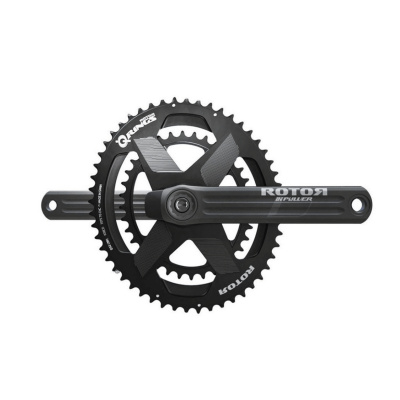
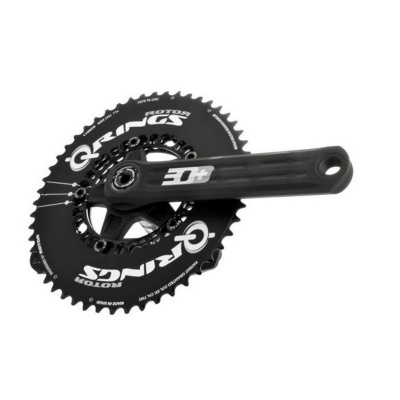
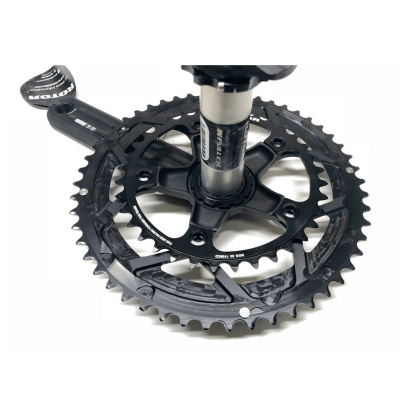
Rotor power meters sit at the sharper end of the training data market - precise, well-engineered, and built around a genuinely joined-up ecosystem. Whether you're pacing a club time trial on the A-roads around Cambridge or grinding out efforts on a long sportive through the Cotswolds, Rotor's range - the INpower, 2INpower, and INspider - delivers +/- 1.5% measurement accuracy straight to your head unit. That's the kind of consistency that makes your power numbers trustworthy, not just decorative.
What sets Rotor apart is the integration with their own oval Q-Rings. Pair any of these power meters with a set of Q-Rings and you unlock OCA (Optimum Chainring Angle) data - a metric that tells you exactly where your oval ring is positioned relative to your pedal stroke. No other power meter ecosystem does this. For riders who've invested in Q-Rings, that's a meaningful reason to stay in the Rotor family.
The range covers most needs. Single-sided, dual-sided, spider-based - there's a logical step-up path. All three models carry IPX7 waterproofing, connect via both ANT+ and Bluetooth Smart, and are built to handle the kind of conditions that make British riding what it is. Mud, spray, a good hosing down. They cope.
Prices and availability can change quickly. Delivery charges are not always included in listed prices.
Final price, stock status and delivery terms are set by retailer. We may receive a commission on purchases made.
How the Rotor Ecosystem Connects
Every Rotor power meter broadcasts on both ANT+ and Bluetooth Smart (BLE) simultaneously. In practice that means you can pair to a Garmin, Wahoo Elemnt, or Hammerhead Karoo without digging through menus or switching modes. Two devices at once - handy if you're running a head unit and a phone app in parallel, or sharing data with a coach remotely via TrainingPeaks.
The Rotor Power app is where the ecosystem gets interesting. It handles firmware updates, lets you configure left/right balance display, and - crucially - manages the OCA and OCP (Optimum Chainring Position) settings for riders running Q-Rings. OCA tells you the angle at which your oval ring is set; OCP gives you the position relative to your crank. Dial both in and you're optimising the ring's resistance curve to your individual biomechanics, not just fitting it and hoping. The app syncs activity data to Strava and TrainingPeaks, so it slots cleanly into most training setups without friction.
The Torque 360 metric is worth knowing about. Rather than giving you a single average power number per pedal revolution, Torque 360 maps your torque output through the full 360 degrees of the stroke - both legs, full picture. It's the kind of data that a bike fitter or coach can actually use to identify asymmetries or dead spots in your pedalling. Not everyone needs it, but if you're chasing marginal gains or coming back from an injury, it's a genuinely useful tool rather than a spec-sheet talking point.
For riders considering alternatives, 4iiii power meters and Favero power meters both offer solid dual-sided options at competitive price points - though neither brings the Q-Rings OCA integration that Rotor's own ecosystem provides.
Battery Life and Cold-Weather Reality
The INpower - Rotor's single-sided, spindle-based unit - runs on a standard AA battery. Up to 300 hours of riding time, and when it dies you swap it on the roadside in under a minute. No cables, no charging schedule. For winter commuters or audax riders who can't guarantee access to a plug, that simplicity matters. Rotor INpower battery life is one of the strongest practical arguments for choosing the single-sided model over its siblings.
The 2INpower and INspider both use built-in rechargeable Li-ion batteries - expect 200 to 250 hours between charges. That's comfortably a month of typical training volume for most riders. Charging is via a magnetic port, and a full charge takes a few hours. The trade-off against the INpower's AA is convenience versus not having to carry a spare battery. On a January ride in the Peak District where temperatures drop fast, the AA option does give you an easy insurance policy if voltage sags in the cold.
Across all three models, the +/- 1.5% accuracy rating holds up through temperature variation. The strain gauges are calibrated to maintain consistency even as metal components contract in cold air - important when you're comparing power files from a July crit to a February base ride and want the numbers to mean something. Rotor power meter calibration via a zero-offset before each ride keeps everything honest; more on that in the FAQ below.
It's also worth noting that the spindle-based and spider-based designs both keep the sensitive strain gauge electronics away from the worst of the drivetrain grime - a small but real benefit when you're regularly riding through the spray that comes off wet Welsh lanes.
Installation, Waterproofing, and Getting Set Up
Fitting the INpower is straightforward - it replaces your existing crank spindle and works with Rotor's ALDHU and VEGAST cranksets. Zero-offset calibration before your first ride is non-negotiable: unclip, put the cranks vertical (6 and 12 o'clock), no weight on the pedals, then hit calibrate in the app or on your head unit. Takes about ten seconds. Do it every ride if you want clean data, especially after the bike's been stored somewhere cold overnight.
The Rotor INspider mounts as a spider between the crank arms and chainring. It's a clean installation visually, and because the measurement happens at the spider rather than in the spindle, it works particularly well for riders who swap chainrings regularly - you're not touching the power meter when you change rings. The INspider is designed for Rotor's own modular cranksets rather than third-party arms, which is a compatibility point worth checking before you buy.
IPX7 waterproofing across the range means submersion to one metre for thirty minutes - in real terms, that's more than enough for road spray, deep puddles, and a jet wash after a filthy ride. The charging port on the Li-ion models has a protective seal; keep it closed and you won't have issues. British winters won't faze them.
For crank arm length options and bottom bracket standards - including threaded, press-fit, and Rotor's own BSA and 386 EVO formats - you'll want to check the Rotor chainsets and cranks and Rotor bottom brackets categories, where compatibility is listed by frame standard. If you need new bearings to complete the build, Rotor bottom bracket bearings are listed there too.
If you're weighing up spider-based alternatives, Quarq power meters offer a comparable spider-based approach and broader crank compatibility - worth a look if you're committed to non-Rotor cranks.
Rotor Power Meters FAQs
How do I calibrate my Rotor power meter?
Open the Rotor Power app or use the calibrate/zero-offset function on your head unit. Position your cranks at 6 and 12 o'clock with no weight on the pedals, then confirm - the whole process takes under ten seconds and should be done before every ride for consistent data.
What battery does a Rotor INpower use?
The single-sided INpower runs on a standard AA battery, good for up to 300 hours of riding time. It's easy to swap mid-ride if needed. The 2INpower and INspider use built-in rechargeable Li-ion batteries instead, with roughly 200 to 250 hours per charge.
Is the Rotor INspider compatible with Shimano cranks?
The INspider is built for Rotor's own modular cranksets - ALDHU and VEGAST - and won't fit Shimano crank arms directly. That said, you can fit a Rotor crankset with the INspider to a Shimano-equipped bike by selecting the correct bottom bracket for your frame standard.