
Rockrider Saddle Bags
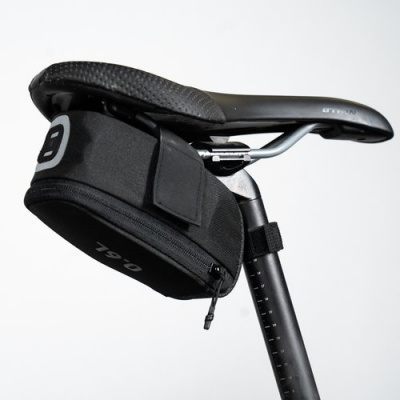
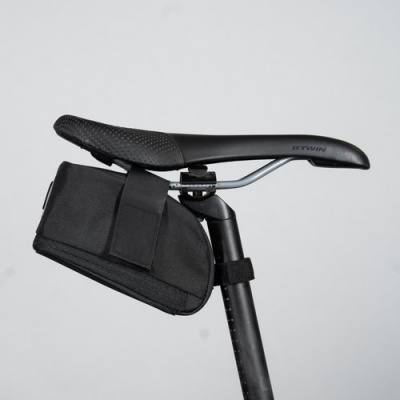
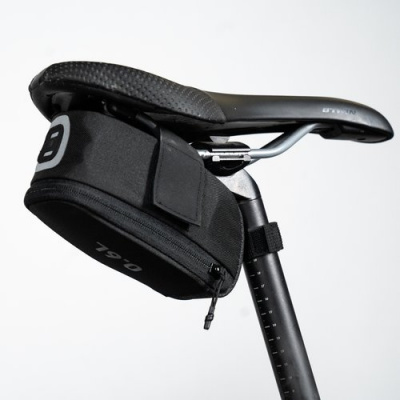
Rockrider saddle bags give you a tidy, no-fuss way to carry trail essentials without loading up a pack - and for most UK riders doing a few hours on the local singletrack, that's exactly the right call. The range tucks neatly under your saddle rails, keeping a spare tube, levers, and a multi-tool within reach without adding noticeable bulk to the ride. Two capacity tiers do most of the work: a compact 0.5L pouch for short, sharp sessions where you want minimal faff, and a roomier 1L-plus option when the day gets longer and you need to squeeze in a 29er tube or a CO2 inflator alongside the tools. Both use tool-free dual Velcro strap mounting systems, so setup takes about a minute in the car park - no fiddly hardware, no scratching around for an allen key. The bags also feature reflective strips as standard, which matters more than people think once the clocks go back and you're finishing rides in the dark. If you're weighing up alternatives, Lezyne saddle bags and Altura saddle bags sit in a similar bracket, but Rockrider consistently punches above its weight on price. Compare the full range below.

Prices and availability can change quickly. Delivery charges are not always included in listed prices.
Final price, stock status and delivery terms are set by retailer. We may receive a commission on purchases made.
Will It Actually Fit Your Bike?
Most Rockrider saddle bags are designed around standard 7x7mm steel and alloy saddle rails, which covers the vast majority of MTB and gravel saddles you'll find on bikes in this price range. If you're running a carbon-railed saddle with 7x9mm rails, check the specific model's listed compatibility before buying - not every bag in the range accommodates the wider profile, and forcing a tight strap over carbon rails risks surface damage over time.
The bigger fitment question for most mountain bikers is the dropper post. Wrap a seatpost strap around a dropper stanchion and you've got two problems: potential scratching of the surface finish, and the strap physically limiting how far the post can drop. On a full-travel trail bike that's a real issue. If your dropper only has 100mm of travel and you're not bottoming it out on every descent, a short lower strap might clear without drama - but it's worth checking with the post fully dropped before you commit. When in doubt, rail-only attachment is the cleaner solution, and some riders simply route the lower strap above the dropper collar rather than around the post itself.
Full-suspension riders also need to think about seatpost clearance at bottom-out. On bikes with high-pivot or aggressive short-link kinematics - the kind that really kick the rear end up under compression - the rear wheel can get surprisingly close to the underside of the saddle. Drop your suspension to sag, compress it by hand as far as it'll go, and check the gap between tyre and bag with the post at your normal riding height. A centimetre of clearance sounds tight but is usually fine; less than that and you risk the tyre clipping the bag on a big hit.
Matching Capacity to What You Actually Carry
The Rockrider saddle bag 0.5L is genuinely small - and that's the point. You'll get one 27.5-inch tube folded reasonably tight, two tyre levers, and a compact multi-tool in there, but it'll be snug. There's no room for CO2 cartridges or anything bulky. For a two-hour loop on familiar ground where you just want puncture insurance, it does the job without adding any noticeable profile under the saddle.
Step up to the Rockrider saddle bag 1L and the maths changes. A 29-inch tube fits without wrestling, and you can realistically add a CO2 inflator, a couple of quick links, and a mid-size multi-tool alongside it. That's a sensible setup for longer days out in the Peak District or on the South Downs where a mechanical mid-ride isn't just inconvenient - it's a proper problem. The semi-rigid thermoformed shells on the premium models help here too: the structure stops the bag collapsing in on itself when it's not fully packed, which keeps everything accessible and prevents the zip from getting stressed by a loose, shifting load.
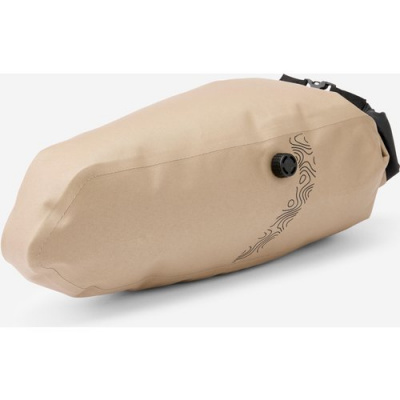
If you're planning anything beyond a standard trail ride - an overnighter, a long-distance gravel route, bikepacking - a saddle bag alone won't cut it for storage. You'll want to look at Rockrider frame bags, Rockrider bar bags, or Rockrider pannier bags to build out a proper carrying system without overloading any single point on the bike.
For riders comparing across brands, Apidura saddle bags and EVOC saddle bags offer more volume at higher price points - worth considering if you're regularly carrying more kit, but for most day-ride scenarios Rockrider's capacity tiers cover the bases without the premium outlay.
Keeping It Clean Through a UK Winter
Saddle bags sit in the direct line of fire from rear-wheel spray. On a wet day in the Brecon Beacons or a gritty forest track in January, that means a constant stream of water, mud, and fine grit aimed straight at the zip and the fabric. Rockrider uses water-repellent fabric across the range, and in practice that handles light rain and the usual trail spray without soaking through. It's not a dry bag - it won't survive being submerged - but for UK conditions it's adequate.
The zip is the weak point over time. Grit works its way into the teeth, the pull gets stiff, and if you ignore it long enough the zip starts to fail. The fix is straightforward: after a muddy ride, rinse the bag off, then run an old toothbrush along the zip teeth to clear any packed grit. Once it's dry, a light application of dry silicone spray keeps the mechanism moving smoothly. Takes two minutes. Worth doing every few rides in winter rather than waiting until the zip is already struggling.
The Vioo Clip compatible mounting loops built into some Rockrider bags are a genuinely useful feature for low-light riding. Clip a Vioo light directly to the bag and you've got rear visibility sorted without needing a separate seat post mount - particularly handy when a dropper post leaves you short of conventional mounting points. Given how quickly the light fades on a December afternoon in the UK, it's the kind of detail that actually earns its keep.
The reflective strips on the bag itself add a passive layer of visibility on top of that - useful when the active light battery dies mid-ride, which inevitably happens at the worst possible moment.
Rockrider Saddle Bags FAQs
How do you attach a Rockrider saddle bag?
Feed the top straps over the saddle rails and cinch them down firmly before pressing the Velcro flat - a loose strap here is what causes bags to rotate and sway on rough ground. Once the rails are sorted, wrap the lower strap around the seatpost and secure it snugly to stop lateral movement on the trail.
Can you use a saddle bag with a dropper seatpost?
A seatpost strap wrapped around a dropper stanchion can scratch the finish and restrict travel - neither is ideal. Look for rail-only mounting options if you run a dropper, or swap to a frame bag if you need the storage without the compromises.
Are Rockrider saddle bags waterproof?
The water-repellent fabrics handle trail spray and light rain comfortably, but they're not fully waterproof under prolonged heavy rain. If you're carrying anything sensitive - a phone, emergency cash - pop it in a small dry bag inside as a simple precaution.