
Maxxis Commuter And Hybrid Tyres
Maxxis commuter and hybrid tyres are built around one simple premise: you need rubber that doesn't let you down at 7:45am on a wet Tuesday. Glass in the gutter, flint washed across cycle lanes, that pothole you clipped yesterday - UK city riding is brutal on tyres, and a puncture mid-commute costs you far more than time. Maxxis addresses that directly with two layers of proprietary protection: SilkShield, a bead-to-bead shield that wraps the entire casing, and MaxxProtect, a poly-fibre layer sitting between the tread and casing to stop debris reaching the tube before it's had a chance to cause damage. The result is a tyre you can run confidently through debris-strewn streets without obsessing over every drain cover. Whether you're on a flat-bar hybrid rolling 700c wheels on a clean suburban route or you need an ECE-R75 e-bike certified 650b option that can handle the extra torque and weight of a mid-drive motor, there's a Maxxis in the range for it. Compare prices across the full range below and find the tyre that turns your commute from a gamble into a routine.
Prices and availability can change quickly. Delivery charges are not always included in listed prices.
Final price, stock status and delivery terms are set by retailer. We may receive a commission on purchases made.
Sizing, Standards, and Frame Clearance
Getting the size right matters more than most riders realise. The two dominant wheel sizes in hybrid and commuter bikes are 700c - the standard road-derived size found on most flat-bar commuters and trekking bikes - and 650b (also called 27.5"), which appears on some touring-oriented hybrids and a growing number of e-bikes. They're not interchangeable, so check your frame's tyre clearance markings before you start comparing tread patterns.
Width matching is where things get a bit more precise. ETRTO standards exist for a reason: running a tyre that's too narrow for your internal rim width puts you at genuine risk of the bead unseating under cornering loads, particularly if you're running lower pressures. As a rough guide, a 32c tyre wants an internal rim width in the 17 - 19mm range, while a 40c or wider needs at least 21mm inside. Most hybrid rims sit in that 19 - 21mm zone, which means there's genuine latitude to go wider if you want more comfort on broken city tarmac - but you need to check frame clearance first. Moving from a 32c to a 40c can eat up 4mm of clearance on each side, and if you run mudguards (which you should, in the UK), that gap vanishes fast. Check at the chainstay bridge and crown - those are usually the tightest points.
For ECE-R75 e-bike certification: this rating confirms a tyre is engineered to handle the sustained speeds, additional weight, and sharper acceleration torque that e-bike motors produce. If your bike is a speed pedelec that assists to 45km/h, ECE-R75 isn't optional - it's a legal and safety requirement. For standard 25km/h assist e-bikes, a quality commuter tyre will do the job, though an e-bike rated option will wear more slowly under that repeated motor-driven load.
Overdrive vs Roamer: Picking Your Weapon
The Maxxis commuter range centres on two distinct models, and choosing between them comes down to the kind of route you actually ride rather than the one you imagine you ride.
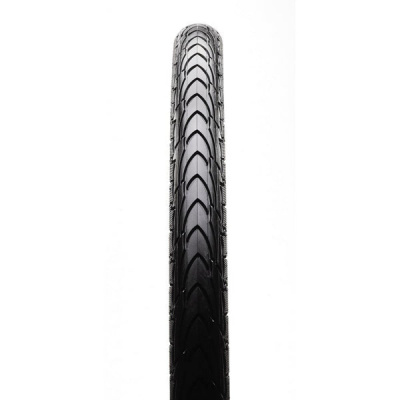
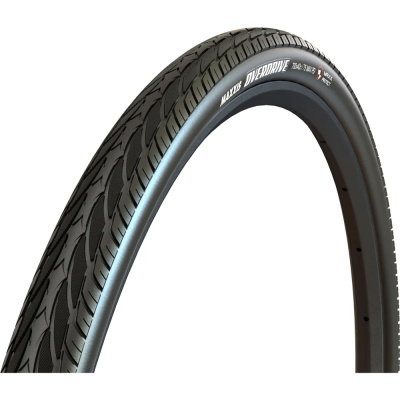
The Maxxis Overdrive is the heavier-duty option. It runs a grooved slick pattern - channels cut into an otherwise smooth tread face - which disperses surface water without the rolling drag of aggressive knobbly tread. Underneath sits MaxxProtect poly-fibre reinforcement, and the whole casing is wrapped in SilkShield bead-to-bead protection. If your commute takes you through streets full of glass, construction debris, or gravel washed across cycle paths after heavy rain, this is the one. It also uses a wire bead in its standard form, which keeps the cost down but adds a small weight penalty over the folding bead variant - worth knowing if you're also factoring in carrying a spare.
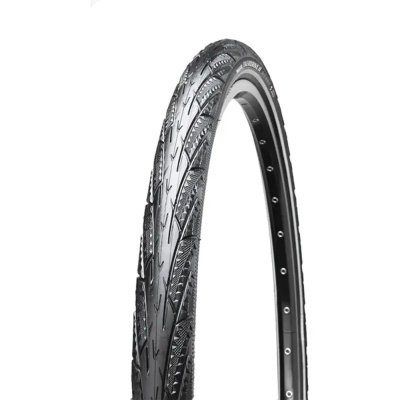
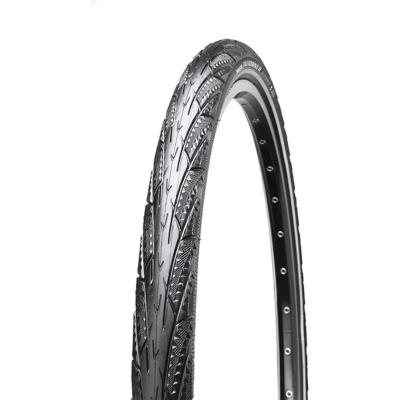
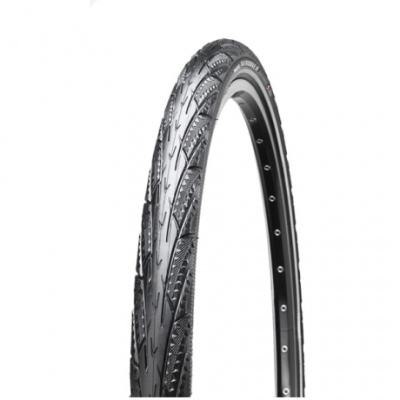
The Maxxis Roamer takes a different approach. The centre strip is smoother for lower rolling resistance on clean tarmac, while a leaf-pattern shoulder tread gives grip when you lean into a roundabout or wet corner. It's quicker-feeling under the wheel, and if your route is mostly well-surfaced roads rather than debris-filled lanes, you'll notice the difference. The trade-off is that it's not as heavily armoured as the Overdrive - it suits riders who prioritise speed and efficiency over maximum puncture resistance.
The TPI count is worth understanding here. TPI (Threads Per Inch) describes casing density: a lower TPI tyre (around 60TPI) is stiffer and more resistant to cuts and impacts - the Overdrive leans this way. Higher TPI casings (120TPI and above) are suppler, conform better to the road surface, and roll faster, but they're more vulnerable to sharp debris. For most UK commuters, especially those on heavier e-bikes or debris-prone routes, the stiffer casing is the pragmatic choice. Riders on cleaner roads who want a bit more feel and speed will find the higher TPI more rewarding. Maxxis also builds Dual Compound rubber into select models - a harder compound at the centre for mileage and durability, softer at the shoulders for grip when you need it. It's a sensible engineering call for commuters who do everything from straight-line charging to filtering through traffic.
If you want to see how Maxxis sits against the competition, Continental commuter and hybrid tyres are a strong alternative - particularly the Contact and Ride series - while Vittoria commuter and hybrid tyres offer some genuinely fast-rolling options for cleaner routes. For a broader look at the category, Specialized commuter and hybrid tyres are worth comparing if you're running a Specialized hybrid and want a guaranteed fit.
Keeping Maxxis Tyres Rolling Through UK Winters
UK cycle lanes in winter are essentially a geological survey of everything sharp that exists: flint chips, broken glass, grit, the occasional screw. Wet weather acts as a lubricant, drawing debris into contact with your tyre surface and giving it a cleaner cut than it would manage on dry rubber. Knowing this, a bit of regular maintenance goes a long way - far more than most commuters bother with until they're late for work with a flat.
Pressure checks every week are non-negotiable on a commuting bike, especially a heavier hybrid or e-bike. Under-inflated tyres sit flatter against the road, increasing the contact patch and the risk of a pinch flat - what mechanics call a snakebite - when you hit a pothole edge-on. Heavier riders and loaded bikes need to be particularly alert to this. Running the correct pressure (check the sidewall for the range, then target the upper end for smooth roads or the lower end if you're on rougher surfaces) costs you nothing and prevents the most common type of commuter flat.
Get into the habit of running your thumb around the tread after a ride. Embedded glass shards are often invisible until they've worked their way through even a SilkShield or K2 Kevlar Composite layer - the K2 system uses a Kevlar composite placed in the casing to resist penetration, but nothing is completely immune if a shard is given enough time and flex cycles to migrate inward. A quick flick with a tyre lever or even a fingernail dislodges most of them before they become a problem. Also, if you're picking up repeated slow punctures in the same spot on the tyre, that's almost always a piece of debris that's partially penetrated but hasn't fully blown - worth investigating before it takes you by surprise.
Pairing your tyres with quality Maxxis inner tubes is a straightforward way to keep the setup consistent - matching tube and tyre brand reduces the chance of sizing mismatch and keeps the bead seating reliably.
Maxxis Commuter And Hybrid Tyres FAQs
Are Maxxis tyres good for commuting?
Very much so. Maxxis builds specific puncture protection into their commuter range - SilkShield wraps the full casing bead-to-bead, and MaxxProtect adds a poly-fibre layer under the tread. The Overdrive in particular is designed to handle glass, flint, and general city debris in wet and dry conditions, making it a dependable choice for daily use.
What is the difference between Maxxis Overdrive and Roamer?
The Overdrive runs a grooved slick tread with heavy-duty puncture protection - it's the tougher, more armoured option for debris-heavy or all-weather routes. The Roamer has a smoother centre strip for lower rolling resistance and a leaf-pattern shoulder for cornering grip. It's quicker on clean tarmac but trades a degree of protection for that pace.
Do I need e-bike specific tyres for my hybrid commuter?
For a standard 25km/h assist e-bike, a robust Maxxis commuter tyre will work, though an e-bike rated tyre handles the extra weight and motor torque more durably over time. For speed pedelecs assisted to 45km/h, you need ECE-R75 certified tyres - it's a legal requirement, and Maxxis covers this in their e-bike range.