
MAAP Helmets
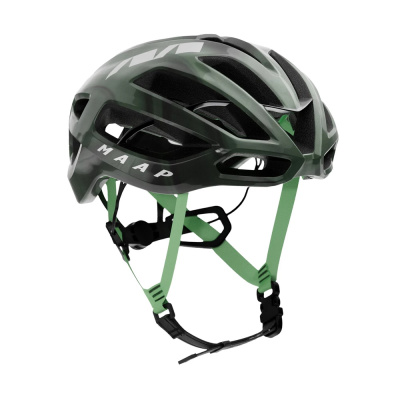
MAAP helmets aren't something the brand makes in isolation - and that's precisely the point. By partnering with Kask, one of the most respected names in road helmet engineering, MAAP brings its signature high-contrast aesthetic to shells that are already trusted at the sharp end of the professional peloton. The result is a small but carefully considered range where the colourways are distinctly MAAP and the performance underneath is uncompromisingly Kask.
Every helmet in the collaboration carries WG11 rotational impact certification, which goes beyond the baseline European safety standard by testing how a helmet manages the angular forces generated in an oblique impact - the kind that causes the most serious head injuries. That's not marketing copy; it's a meaningful step up in protection. Pair that with wind-tunnel-developed aerodynamic profiles and retention systems precise enough to dial out pressure points on a four-hour ride, and you've got headwear that works as hard as the kit underneath it.
For UK riders, the range is particularly relevant. MAAP's high-contrast colourways improve low-light visibility on grey winter mornings, and the ventilation design on models like the Protone Icon handles the humid, stop-start effort of a lumpy British climb without cooking your head. Worth a proper look.
Prices and availability can change quickly. Delivery charges are not always included in listed prices.
Final price, stock status and delivery terms are set by retailer. We may receive a commission on purchases made.
Safety Tech and Aerodynamic Performance
The engineering story starts with WG11, Kask's rotational impact testing protocol. Standard ECE and EN certifications check that a helmet absorbs direct linear impacts - a falling-straight-down scenario. WG11 adds oblique impact testing at real-world angles, measuring how well the helmet manages the rotational forces that travel into the skull and brain during a typical road crash. It's a more honest simulation of what actually happens, and helmets that pass it have demonstrably better protection profiles than those certified to the baseline standard alone.
The shell construction uses MIT technology - a polycarbonate layer that's moulded directly with the EPS foam rather than simply glued on. Think of it less as a skin and more as a structural element: it distributes impact loads across a wider area and resists the kind of shell cracking that can compromise protection before the foam even engages. On a long descent on the A470 or hammering a fast crit circuit, that structural integrity matters.
Aerodynamics on the Protone Icon are a studied balance rather than a simple drag-reduction exercise. The seamless shell profile was developed in the wind tunnel to reduce turbulence across a range of head angles - including the slightly raised position most riders default to on longer efforts. Ventilation isn't sacrificed entirely for aero gains; the port placement is calculated to channel air across the scalp rather than just opening holes in the shell. It's not as aggressively ventilated as a pure climber's helmet, but it's significantly cooler than a closed aero lid.
Understanding the MAAP Helmet Range and Fit
Are MAAP helmets just Kask helmets? Not quite. The collaboration model means MAAP works with Kask to produce exclusive colourways and graphic treatments on proven Kask platform models - the Protone Icon being the headline example. You're getting Kask's full safety, fit, and aerodynamic engineering with MAAP's visual identity applied to it. There's no compromise on the underlying product; it's the same shell, the same retention system, the same padding as the standard Kask versions.
Fit is where Kask helmets have always had a strong case. The OctoFit retention system uses a floating cradle design - eight contact points that flex independently to follow the shape of your head rather than clamping a rigid hoop around it. The micro-dial gives precise adjustment in small increments, and crucially, the cradle adjusts both horizontally and vertically. That vertical range is genuinely useful if you've ever worn a helmet that sits fine around the circumference but rocks forward or sits too high at the back. Check the fit at home before your first big ride: dial it in standing still, then shake your head firmly in all directions. It shouldn't shift.
The internal shape tends toward a slightly oval profile, which suits a broad range of head shapes but may feel snug at the sides for riders with rounder heads. Sizing runs true - measure the circumference just above your ears with a flexible tape and match it to the size chart. If you're right on a boundary, consider your head shape: rounder heads often size up, more oval heads can size down. Pair the helmet with a set of MAAP jerseys and you've got a coherent kit that photographs well and performs better.
UK Riding: Ventilation, Caps, and Keeping It Fresh
British summer riding has a particular problem: it's rarely hot enough to justify a pure aero lid, but it's often humid enough to make you sweat harder than the temperature suggests. The Protone Icon's ventilation handles that reasonably well - the port geometry encourages airflow even at the lower speeds typical of a grinding Welsh valley climb rather than a flat-out descent. It won't match the through-draft of a dedicated lightweight climber's helmet, but for mixed riding it's a reasonable middle ground.
Which MAAP helmet suits hot weather best? If pure ventilation is the priority on summer days - a long Alpine-style effort or a scorching sportive - the MAAP x Kask Valegro is the call. It's optimised for maximum airflow and minimal weight, built for riders who want to feel as little helmet as possible over four hours of climbing. For everything else, including most UK riding conditions, the Protone Icon covers more bases.
Winter and autumn rides raise a practical question: can you fit a cycling cap underneath? Yes, without much fuss. A thin thermal cap sits comfortably under the retention cradle on Kask helmets, and the OctoFit dial gives you enough range to accommodate the extra layer without the helmet sitting awkwardly high. A heavier knitted cap works too, though it will reduce the effective ventilation - which in January is rarely a problem. Match it with MAAP base layers for a properly integrated cold-weather setup.
Maintenance is straightforward but worth doing regularly. The 3D Dry padding and Merino wool internal pads are removable and should be hand-washed in cool water with a mild detergent every few weeks if you're riding hard. Salt from sweat accelerates foam degradation and encourages bacterial growth - both of which shorten the life of the padding and make the helmet unpleasant to wear. Let the pads air-dry fully before refitting; Merino in particular loses its structure if tumble-dried. The shell itself just needs a wipe with a damp cloth; avoid solvent-based cleaners, which can weaken the polycarbonate. A good helmet is worth looking after, and these aren't cheap to replace. Round out your kit with MAAP socks and MAAP road shoes while you're at it - the colourway coordination across the range is one of MAAP's genuine strengths.
MAAP Helmets FAQs
Are MAAP helmets just rebranded Kask helmets?
Not rebranded - collaborated. MAAP works with Kask to apply exclusive colourways and graphics to Kask's proven helmet platforms. The underlying engineering, safety certification, fit system, and construction are all Kask's own. You're getting the full Kask product with MAAP's aesthetic on top, not a cut-down version.
How do I choose the right size for a MAAP x Kask helmet?
Measure your head circumference just above your ears using a flexible tape measure, then match it to the size chart. Kask helmets run true to size in most cases. The OctoFit system offers enough adjustment range to fine-tune the fit, but getting the right shell size first is the starting point - the retention system isn't a substitute for correct sizing.
Which MAAP helmet is best for summer riding?
For maximum airflow on hot days, the MAAP x Kask Valegro is the lightweight, high-ventilation option. If you want a helmet that handles both warm days and mixed conditions without switching lids, the Protone Icon balances aerodynamic efficiency and cooling well enough to cover most situations in a UK summer.