
J.guillem Gravel Bikes
J.Guillem gravel bikes are built around a single, clear idea: aerospace-grade titanium, done properly, for riders who want one bike that handles everything from fast tarmac to grim bridleways without compromise. Every frame J.Guillem produces uses 3Al/2.5V aerospace titanium - the same alloy spec used in aircraft hydraulic systems - which gives you a material that's simultaneously light, tough, and corrosion-proof. No paint to chip, no rust to worry about after a winter hammering on salted lanes.
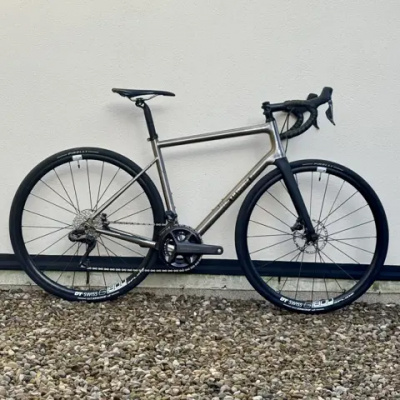
The flagship Atalaya is where their gravel thinking lives. It's not a touring bike with dropped bars bolted on - the geometry leans toward sharp, engaged, and responsive, the kind of ride that rewards you when you're pushing hard out of a muddy corner in the Peak District rather than plodding along a canal towpath. You can buy it as a bare frameset for a custom build or as a complete factory bike, typically specced with Shimano GRX or SRAM AXS groupsets depending on your budget. Tyre clearance runs to 700c x 40mm or 650b x 2.1 inches, so you've got real flexibility across seasons. Compare the latest UK prices on full builds and framesets below.
Prices and availability can change quickly. Delivery charges are not always included in listed prices.
Final price, stock status and delivery terms are set by retailer. We may receive a commission on purchases made.
Decoding the J.Guillem Gravel Lineup
J.Guillem keep things focused. There's no sprawling catalogue to navigate - the Atalaya is their dedicated gravel platform, and it comes in two buying routes: frameset or complete build. The frameset option suits riders who already have a groupset they love, or those chasing a specific weight target with a custom component selection. Complete builds typically arrive with Shimano GRX or SRAM AXS, covering the spread from mechanical budget-conscious builds to fully wireless setups for those who want no cables cluttering the cockpit.
Geometry-wise, the Atalaya sits closer to fast all-road than expedition tourer. The stack and reach numbers favour an athletic position - you're not sat bolt upright - which means the bike responds when you want to put power down. It's snappy out of the saddle on short punchy climbs, not sluggish. That said, it's not so aggressive that a three-hour gravel ride leaves you wrecked. Think of it as a road bike that's been given permission to get its tyres dirty, rather than a mountain bike that's been calmed down. If you're weighing up comparable titanium options at this end of the market, Kinesis gravel bikes offer an interesting point of comparison - particularly the Tripster range - though J.Guillem's construction methods and alloy spec sit in a different bracket.
Why the Frame Construction Actually Matters
Not all titanium frames are equal, and this is where J.Guillem's approach separates from cheaper Ti offerings. The 3D-cast titanium dropouts are a good place to start. Cast dropouts maintain far tighter tolerances than welded equivalents, which means your thru-axle sits perfectly aligned every single time. Misaligned dropouts cause disc brake rub and uneven bearing wear - issues that plague lower-cost titanium frames built with simpler fabrication methods. Here, precision is baked in from the manufacturing stage.
The cast titanium head tube and bottom bracket shell follow the same logic. Casting these high-stress junctions - rather than welding tube-to-tube - eliminates the micro-flex that can make cheaper titanium frames feel vague under hard efforts. Power transfer at the bottom bracket is direct and stiff, which matters when you're grinding up a gritstone climb or sprinting for a gate on a bridleway. Flex belongs in the tubes, not the joints.
And the tubes do flex - deliberately. The seamless hydroformed 3Al/2.5V tubing is shaped to tune compliance into specific parts of the frame, particularly the seatstays and fork. This isn't the frame flexing because it's weak; it's the frame absorbing the constant high-frequency chatter of loose gravel and rough tarmac so your hands and lower back don't have to. After four hours on mixed Welsh surfaces, that distinction is the difference between arriving fresh and arriving wrecked. Internal cable routing keeps the aesthetic clean and protects cables from the grit and salt that would otherwise chew through outers within a season.
Living with a J.Guillem in the UK
Owning unpainted titanium in Britain is genuinely low-maintenance in a way that painted aluminium or carbon simply isn't. Road salt is brutal on finishes - anyone who's watched a pristine paint job bubble and peel after one wet winter knows the feeling. Bare titanium doesn't care. It doesn't rust, it doesn't corrode, and if you scratch it - which you will, eventually - a light pass with a Scotch-Brite pad brings the brushed finish back without drama. That's a practical reality that matters if you're riding year-round on UK lanes.
The 700c x 40mm or 650b x 2.1-inch tyre clearance gives you genuine seasonal flexibility. Run 700c x 32mm in summer when the hardpack is fast and dry, then drop to 650b wheels with wider rubber when the Welsh winter slop arrives and grip becomes the priority. The geometry adjusts subtly with the wheel size change - the 650b setup lowers the bottom bracket slightly and shortens the effective wheelbase, which can sharpen handling on technical, rooty tracks. Hidden mudguard mounts mean you can clip on guards for winter club runs without the frame looking like an afterthought, and rack mounts open up light touring and bikepacking use without needing a dedicated luggage-specific frame.
Speaking of bikepacking - unpainted titanium is arguably the ideal surface for strapping heavy bags. Paint rub from frame bags and top tube pouches leaves permanent marks on painted frames; on bare Ti, any scuffs from straps or buckles are superficial and largely invisible. Throw the bags on, load up, and don't overthink it. For riders building a long-distance kit around the Atalaya, it's worth pairing it with appropriate bikepacking luggage and gravel-specific tyres. Genesis gravel bikes are another British-market option worth considering if the titanium price point feels like a stretch, though you're trading material properties significantly. J.Guillem also produce road bikes using the same titanium construction principles, so if you end up impressed by the Atalaya's ride quality, their road range is a logical next step.
Flat mount disc brakes are standard throughout, compatible with the current generation of gravel groupsets without any adapter faff. Tyre clearance and geometry aside, this is a bike that plays nicely with modern components - you're not hunting for obscure standards or workarounds.
J.guillem Gravel Bikes FAQs
Are J.Guillem bikes made of titanium?
Yes. J.Guillem build exclusively with aerospace-grade 3Al/2.5V titanium - the same alloy spec used in aircraft components. It gives the frames an exceptional strength-to-weight ratio, a naturally compliant ride character, and complete resistance to corrosion, with no paint required.
What is the maximum tyre clearance on a J.Guillem Atalaya?
The Atalaya clears up to 700c x 40mm or 650b x 2.1-inch tyres. That dual-wheel compatibility means you can run fast, narrow rubber in summer and switch to wider 650b rubber for muddy winter conditions, all on the same frame.
Is the J.Guillem Atalaya good for bikepacking?
Very much so. The frame includes hidden mudguard mounts and rack mounts for light touring loads. Unpainted titanium also handles frame bag contact and strap rub far better than painted frames - any marks are superficial and the finish won't deteriorate the way powder coat or lacquer does under loaded riding.