
J.guillem Road Bikes
J.Guillem road bikes sit in a rare category: aerospace-grade 3Al/2.5V titanium frames built to a standard that genuinely competes with top-tier carbon on performance, then outlasts it by decades. The Dutch-founded brand uses seamless hydroformed tubing and one-piece cast titanium headtubes to produce shapes you'd expect from a carbon layup - sharp front-end stiffness, directionally tuned tube profiles - wrapped in a material that simply doesn't care about winter grit, road salt, or the odd kerb clip.
Three road models cover distinct riding briefs. The Formentor pushes aggressive, aero-optimised geometry for riders who want race feel in a metal frame. The Major sits in the middle - fast, versatile, comfortable enough for back-to-back days without feeling like a compromise. The Orient stretches into endurance and year-round riding, with the practical mounts and tyre clearance that UK conditions genuinely demand. All three share the same meticulous titanium construction; the differences are in geometry and intent.
If your riding regularly takes you beyond the tarmac onto bridleways and gravel lanes, have a look at our J.Guillem Gravel Bikes collection - the geometry and mounts there are built specifically for mixed-surface work.
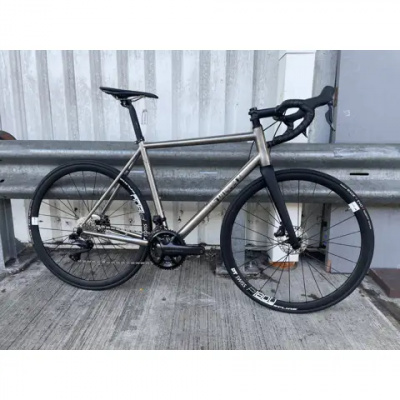
Prices and availability can change quickly. Delivery charges are not always included in listed prices.
Final price, stock status and delivery terms are set by retailer. We may receive a commission on purchases made.
Decoding the J.Guillem Road Lineup
Three models, three clear briefs - and it's worth knowing which one matches how you actually ride before you start configuring a build. The Formentor is the sharpest tool in the range. Its geometry is aggressive: low front end, compact stack, the kind of numbers that make sense if you're chasing fast group rides or want a titanium frame that handles closer to a Factor road bike than a touring machine. It's the J.Guillem for riders who refuse to accept that choosing metal means accepting a softer, more relaxed ride.
The Major is the all-rounder, and likely the most versatile frame in the lineup. Geometry is race-inspired without being punishing - you can put in a proper four-hour road ride and still feel human at the end. It suits riders who want one bike to handle club runs, sportives, and the odd fast solo effort without needing to swap frames between seasons. Think of it as the daily driver with enough performance credentials to hold its own on a fast group ride.
The Orient takes a different line. Endurance geometry, relaxed head angle, longer wheelbase - it's built for riders who cover serious distances or want a four-season machine that won't beat them up on rough B-roads. Wider tyre clearance and full mudguard mounts make it genuinely practical for UK riding in a way the Formentor simply isn't designed to be. If you're comparing within the range, the J.Guillem Orient vs Major decision usually comes down to one question: are you prioritising outright pace or year-round usability?
The J.Guillem Tech Philosophy
The material choice underpins everything. 3Al/2.5V titanium - the same alloy specification used in aerospace applications - gives J.Guillem frames a strength-to-weight ratio that justifies the price bracket. But the alloy is only part of the story. What separates these frames from more basic titanium builds is how the tubes are processed. Seamless hydroformed 3Al/2.5V titanium tubing allows J.Guillem to shape each tube with the kind of precision you'd normally associate with carbon monocoque construction - ovalisations, tapers, and cross-section changes that direct stiffness exactly where it's needed.
The one-piece cast titanium headtubes are worth understanding. A welded headtube junction is a stress concentration point - it's where flex and fatigue tend to accumulate over years of hard riding. By casting the headtube as a single piece, J.Guillem removes those weld-stress points entirely, giving you a front end that's stiffer, more precise, and structurally more durable over the long term. Paired with 3D cast titanium dropouts, the approach is consistent: remove weld seams from high-load areas wherever the manufacturing process allows.
Directional tube shaping for bottom bracket stiffness is the other headline. The down tube and chainstay profiles are shaped to resist lateral flex under hard pedalling efforts - so the frame doesn't bleed watts when you're out of the saddle on a climb. This is the engineering that allows J.Guillem to argue, credibly, that their bikes don't feel like a stiffness compromise compared to carbon alternatives from brands like Cervélo or Condor. Internal cable routing keeps the aesthetic clean and reduces wind noise - a small detail, but one that matters on a frame you'll own for fifteen years.
The J.Guillem Formentor frameset is available in the UK as a standalone build platform, which means you can spec components to match your exact requirements rather than accepting a stock groupset. For riders who've been building dream bikes in their heads for years, that flexibility is a significant part of the appeal.
Living with a J.Guillem in the UK
Bare titanium and British winters are a genuinely good match - and not just in theory. Road salt corrodes aluminium over time, chips paint off steel and carbon, and eventually works its way into unprotected surfaces. Unpainted 3Al/2.5V titanium doesn't oxidise the same way. You can ride through January slop, hose the bike down, and the frame comes up looking exactly as it did the day you built it. No touch-up paint, no corrosion creeping under the clearcoat. For riders who use their road bike year-round, that's a practical advantage that compounds over a decade of ownership.
The Orient's clearance for 32c tyres is relevant here. A 32c tyre on rough B-roads absorbs the kind of chip-seal chatter and pothole impact that a 25c setup transmits directly into your hands and lower back. Fit mudguards - the Orient has the mounts for full-length guards - and you've got a road bike that handles a wet Wednesday evening ride without covering you in spray. That's not a compromise build; that's a sensible one for anyone doing regular miles in this country.
The T47 bottom bracket standard deserves a mention because it solves a real problem. Press-fit bottom brackets offer stiffness but are notoriously prone to creaking, especially in wet conditions - the kind of persistent, ride-ruining creak that's hard to diagnose and irritating to fix. T47 gives you a threaded shell (so installation is straightforward, servicing is easy, and creaking is rare) with an oversized diameter that delivers the bottom bracket area stiffness of a press-fit design. For UK miles - and UK winters specifically - it's the right call. You'll thank it on a damp November club run when everyone else is diagnosing mystery noises.
One practical note on building a J.Guillem: because these frames are sold as framesets as well as complete builds, it's worth deciding early whether you're transferring an existing groupset or specifying fresh. Either way, check compatibility with the T47 shell and the internal routing ports - modern electronic groupsets route cleanly, but it's worth confirming battery port placement before you commit to a cable run.
J.guillem Road Bikes FAQs
Are J.Guillem bikes good?
They're highly regarded among riders who know their titanium. Weld quality, tube shaping, and proprietary cast components put them firmly in the premium bracket - and unlike carbon, a well-maintained J.Guillem frame doesn't have a use-by date. You're buying something built to last a very long time.
Where are J.Guillem frames made?
J.Guillem frames are designed in the Netherlands by founder Jan-Willem Sintnicolaas and manufactured in Taiwan. Taiwan is the global benchmark for precision titanium bicycle fabrication - the same manufacturing ecosystem that produces frames for several of the world's most respected high-end brands.
What is the difference between the J.Guillem Major and Orient?
The Major is a fast, race-inspired all-rounder with geometry that suits performance road riding. The Orient is the endurance and four-season model - it has a more relaxed position, clearance for wider tyres up to 32c, and mounts for mudguards, making it the more practical choice for UK year-round riding and longer days in the saddle.