
Castelli Wetsuits
Castelli wetsuits carry the same obsession with speed that's made the brand a fixture on pro pelotons - only here it's aimed squarely at the water. Designed for triathletes and competitive open-water swimmers, each suit is built around three priorities: maximum buoyancy to lift your hips, unrestricted shoulder mobility through the catch and pull, and fast removal when you hit T1. Variable-thickness neoprene does the heavy lifting - thicker panels across the core and hips keep your body position high and flat, while thinner panels around the arms and lats let you actually swim without turning your shoulders to concrete after 400 metres.
For UK riders doubling as triathletes, that thermal retention matters from April through to October, when lake temperatures in the Peak District or Scottish Highlands can sit well below what a continental race calendar might prepare you for. Castelli's hydrodynamic coatings reduce water adhesion across the outer surface, so you're slipping through rather than ploughing. If you're targeting a sprint distance local open-water event or building toward a full Ironman, there's a suit in the Castelli range calibrated to your pace, your water temperature, and your transition speed. Here's what separates the options.
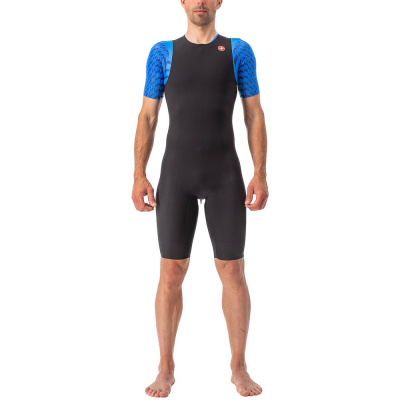
Prices and availability can change quickly. Delivery charges are not always included in listed prices.
Final price, stock status and delivery terms are set by retailer. We may receive a commission on purchases made.
Fabric Tech and Hydrodynamics: What's Actually in the Rubber
Castelli's performance wetsuits are built around Yamamoto neoprene - Japanese-sourced rubber that offers a noticeably higher stretch-to-weight ratio than standard neoprene, and better durability under repeated use. You feel the difference in the shoulder panels first: there's a give and rebound quality that cheaper suits simply don't replicate, and it doesn't degrade after a season of weekly lake swims.
Variable thickness profiling is where the real engineering sits. Panels across the chest, core, and hips run at around 4mm - thick enough to generate meaningful buoyancy and keep your lower body riding higher in the water, which directly reduces drag. The arms, lats, and shoulder zones drop to 1.5mm or 2mm, because adding neoprene bulk there actively harms your stroke mechanics. A tight 1.5mm panel lets you rotate freely through the catch phase without fighting the suit on every pull. Over a 1,500-metre open-water swim, that matters.
The outer surface carries an SCS (Super Composite Skin) hydrodynamic coating. Think of it as a low-friction skin over the neoprene - water beads and releases rather than gripping the surface, which keeps resistance down and makes the suit feel faster once you're moving at race pace. It also makes the suit easier to strip in transition, which is a practical benefit that compounds over a race.
For shingle beach entries - a staple of UK coastal events from Dorset to Northumberland - Yamamoto rubber's durability holds up better than softer alternatives. Still worth a careful entry rather than a belly flop, but it's not going to scuff through after a season.
Getting the Castelli Wetsuit Fit Right
A properly fitted Castelli wetsuit should feel uncomfortably snug on dry land. Not 'can't breathe' tight, but noticeably compressive across the chest and torso. That's correct. Once you're in the water, a thin micro-layer enters the suit and the neoprene relaxes slightly - and that's when the fit becomes what it's designed to be. If it feels comfortable standing in the car park before the race, it's probably a size too big.
Sizing up for comfort is the most common mistake with performance wetsuits. A loose suit doesn't just feel baggy - it pools water inside the panels, and you end up dragging that water with you through every stroke cycle. That's far more fatiguing than the initial snugness of the correct size. Check Castelli's sizing charts carefully; height and chest/hip measurements both matter, and different suits in the range have slightly different cuts depending on the intended use.
Shoulder mobility is the real test when trying a suit on. Lift both arms overhead, then simulate the catch motion of a freestyle stroke. You should feel resistance - the suit is doing something - but you shouldn't feel your movement being blocked or your stroke pattern forced into something unnatural. If the shoulders are restricting your range of motion beyond that, try the next size or a different panel configuration. Pairing the suit with the right base layer underneath also affects perceived fit; check our Castelli base layers for options that work cleanly under race kit.
For race-day integration, what you wear under the wetsuit affects both comfort and transition speed. Castelli's own Castelli skinsuits are cut to work directly under the wetsuit without bunching at the torso, which matters when you're trying to strip down in under 60 seconds at T1.
UK Open Water Performance and T1 Transitions
UK open water temperatures are unforgiving in the early season. Lake Windermere in May sits around 12 - 13°C. Welsh reservoirs used for club triathlons can be colder. The 4mm core panels in Castelli's performance suits provide genuine thermal retention in that 12 - 15°C range - you'll still feel the cold on exposed areas like face and hands, but the core warmth is maintained over race distance. For anything below 10°C, neoprene accessories - cap, booties - are worth adding regardless of which suit you're wearing.
Transition design is built into the suit's construction rather than bolted on. Quick-release ankle cuts mean the leg openings are designed to peel away rapidly rather than snagging over your timing chip or heel. The inner lining of a good Castelli suit is deliberately slippery - water-lubricated neoprene sheds fast, and the suit rolls down and off without the usual fumbling. Practise the removal motion before race day; even a well-designed suit rewards rehearsal.
After every swim - lake, sea, or pool - rinse the suit thoroughly with fresh cold water. Salt water degrades neoprene from the inside out if left to dry in the fabric. Chlorine does the same, slightly slower. Hang the suit inside-out on a wide hanger, away from direct sunlight, and let it dry fully before storing. Never use a wire hanger; the weight of a wet suit on a narrow point will crease and eventually crack the neoprene at the hang point. Fold it loosely for storage, don't compress it into a kit bag for weeks at a time.
If you're travelling to events and need carry options, Castelli's own Castelli holdalls are sized to handle a wetsuit without forcing it into awkward compression. Worth considering if you're racing multiple events through the season.
One honest limitation: Castelli wetsuits sit at the performance end of the price bracket. If you're new to open-water swimming and uncertain whether triathlon will become a regular part of your calendar, the entry cost requires some confidence in your commitment to the sport. That said, the durability of Yamamoto neoprene means a well-maintained Castelli suit has a longer usable life than cheaper alternatives - the cost-per-swim maths tends to balance over two or three seasons of regular use.
Castelli Wetsuits FAQs
How should a Castelli wetsuit fit?
Snug to the point of uncomfortable on dry land - that's the target. Once you're in the water, a thin layer enters the suit and the neoprene relaxes slightly into the correct race fit. If it feels fine standing still before a swim, it's likely a size too large and will pool water during the stroke.
Are Castelli wetsuits suitable for UK open water swimming?
Yes. The thicker core panels - typically around 4mm - provide solid thermal retention in the 12 - 15°C lake temperatures common across UK events from spring through autumn. For swims below 10°C, add neoprene accessories like a swim cap and booties; no suit alone is enough in serious cold.
How do I wash and store my triathlon wetsuit?
Rinse with fresh cold water immediately after every swim to clear salt, dirt, or chlorine. Hang inside-out on a wide hanger away from direct sunlight until fully dry. Avoid wire hangers, tight folding for extended periods, and any heat source - all of them shorten neoprene life faster than the swimming does.