
Campagnolo Saddle Bags
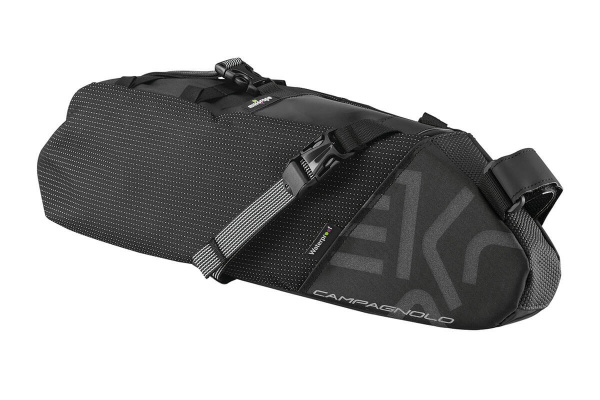
Campagnolo saddle bags are built around a simple idea: if you're running a Campa groupset, your storage shouldn't undermine what the rest of the bike is doing. No swaying brick under the saddle, no nylon bulk catching the wind, no chafing against your bibs on a long club run. These bags sit tight, tuck neatly between the saddle rails, and carry exactly what you need to get home - a spare tube, levers, a CO2 - without advertising themselves to the person sitting on your wheel.
They're compact, aerodynamically profiled to complement a road bike's lines rather than fight them, and built with water-resistant coated fabrics and sealed zippers that shrug off rear-wheel road spray rather than drinking it in. That matters here. UK roads throw grit, standing water, and general filth at the underside of your saddle on a daily basis, and a tool kit full of rust is no use when you're ten miles from the car on the North Downs in October.
Campagnolo keep the range focused: these are minimalist road and gravel bags, not touring luggage. Pick the right size, attach it properly, and it becomes invisible - which is exactly the point.
Prices and availability can change quickly. Delivery charges are not always included in listed prices.
Final price, stock status and delivery terms are set by retailer. We may receive a commission on purchases made.
How They Attach and What to Watch For
Most Campagnolo saddle bags use a dual-point system: a strap that loops over the saddle rails and a secondary seatpost strap that cinches the tail down to stop it swinging. The anti-abrasion Velcro straps are designed with carbon components in mind - the contact surfaces are padded to avoid marking a lightweight carbon seatpost or cutting into carbon saddle rails the way a standard webbing strap can over time. That said, don't over-tighten. Carbon rails are vulnerable to point-load pressure, and snugging a strap down past firm is how you introduce stress cracks that won't show until it's too late.
Saddle rail clearance is worth checking before you buy. Bags with a wider body need more vertical space between the rails and the top of the rear tyre, and if you're running a compact frame with a short saddle-to-tyre gap, a bulkier bag can foul the wheel in the worst case or just sit at an awkward angle in the best. Aero seatposts - particularly those with integrated clamps or teardrop profiles - can also complicate strap routing, so verify the seatpost strap length against your post's circumference before committing.
If you're heading somewhere that needs more than a small bag can carry - think multi-day riding or a loaded audax - a saddle pack isn't the right tool. Have a look at Campagnolo frame bags for a more practical carrying solution that keeps weight centred and balanced on the bike.
Micro vs. Standard: Knowing What You Actually Need
Campagnolo's saddle bag range splits broadly into two capacities, and the choice is straightforward once you're honest about what you carry. The micro or aero format is built around a single lightweight inner tube, a pair of tyre levers, and one CO2 canister. That's it. There's no room for ambition. It's the bag you want when the priority is aerodynamic profile and keeping the package as small as possible - road racing, sportives, fast chain-gang rides where stopping is a social embarrassment anyway.
The standard size opens up a bit more room: you can add a multi-tool with basic functions, a patch kit for longer days, and a spare quick link if you're the type who thinks ahead. Still compact by any reasonable measure, but it gives you a fighting chance if something goes properly wrong twenty miles from anywhere. The aerodynamic profile is retained - Campagnolo's shaping keeps the bag tucked rather than projecting into the airstream - but you get that extra layer of self-sufficiency. For most UK riders doing mixed road and gravel, the standard size is the sensible call. Check out Campagnolo tools to make sure your multi-tool selection actually fits the bag you're buying.
For context, Apidura saddle bags and Lezyne saddle bags offer larger-volume options if you need to carry more kit, but that extra capacity comes with a trade-off in aerodynamics and how the bag sits on the bike. Campagnolo's bags are deliberate about staying small - that's not a limitation so much as a positioning choice. If you want proper carrying capacity, look at packing differently rather than forcing it into a seat pack. Wheel transport is a different problem entirely, and Campagnolo wheel bags handle that side of things.
Keeping Your Bag Working Through a UK Winter
Rear-wheel spray is the enemy of saddle bag zippers. Grit and road salt work into the zip teeth over time, and what starts as slight stiffness becomes a zip that won't move when you're standing at the side of the road in the rain with a flat. The water-resistant coated fabrics and sealed zippers on these bags resist moisture well, but they're not self-cleaning.
After muddy or wet rides, run an old toothbrush along the zip teeth to clear any embedded grit, then work a small amount of silicone lubricant into the mechanism. Don't use a petroleum-based product - it degrades the waterproof coating on the fabric around the zip over time. A dry silicone spray or a dedicated zip lubricant is the right call. Do this every few weeks through winter and your zippers will stay smooth; ignore it and you'll be forcing a jammed zip open at exactly the wrong moment.
It's also worth removing the bag entirely every month or so to clean the seatpost underneath. Road grit trapped between the bag's straps and the seatpost acts like very fine sandpaper, and on a carbon post that's a problem that compounds quietly. Wipe the post down, check the strap contact points for wear, and reattach with clean hands. Thirty seconds of attention prevents a repair bill.
In genuinely heavy rain - not the usual UK drizzle, but full-on winter downpours - the sealed zippers do an impressive job, but they're not submersible. Anything electronic or susceptible to moisture (car key fob, for instance) wants to go in a small zip-lock bag inside the main pocket. The bags cope well with road spray and sustained light rain; a prolonged soaking in a Welsh valley is a different test. If waterproofing in extreme conditions is a priority, Castelli saddle bags and Brooks saddle bags offer alternative approaches worth comparing for your specific use case.
Campagnolo Saddle Bags FAQs
What fits inside a Campagnolo saddle bag?
In a micro bag, you're looking at one lightweight inner tube, two tyre levers, and a CO2 canister - that's a full house. Step up to a standard size and you can add a compact multi-tool, a patch kit, and a spare quick link, giving you enough to handle most roadside mechanicals without doubling the bag's footprint.
How do you attach a Campagnolo saddle bag?
The straps loop over the saddle rails and wrap around the seatpost, with anti-abrasion Velcro contact points to protect carbon components. Get the seatpost strap properly firm - not wrenched tight, just secure - and the bag won't sway or chafe against your bib shorts. Check the seatpost strap length is compatible with your post's profile before buying, particularly if you're running an aero-section seatpost.
Are Campagnolo saddle bags waterproof?
Water-resistant is the accurate description - coated fabrics and sealed zippers handle road spray and sustained drizzle well, which covers most UK riding. In a serious downpour, the protection is good but not absolute. Wrap anything sensitive (a car key fob, for example) in a small plastic bag inside the pocket as a simple precaution.