
Argon 18 Time Trial & Triathlon Bikes
If you're serious about the bike leg, Argon 18 Time Trial & Triathlon bikes are built around one idea: removing every second the wind, the fit, and the frame can cost you. The Montreal brand has form at the sharp end - Kona podiums, UCI WorldTour TT stages, and a development programme that treats aerodynamic drag as the enemy and rider position as the weapon. These aren't bikes that look fast. They're bikes designed to be fast, with geometry, integration, and carbon layup dialled from the top down.
The range splits cleanly between long-distance triathlon machines and UCI-legal time trial weapons, so whether you're racing a CTT 10 on a local A-road or pacing yourself through 180km at an Ironman, there's a model built around your specific demands. Fit matters enormously in this category - front-end stack, reach, and aero bar width all feed into how much power actually reaches the road versus fighting your own body position.
Looking to build your aero weapon from the ground up? We also track prices on bare framesets - head over to our dedicated Argon 18 Frames page to find your perfect starting point. Otherwise, read on for a full breakdown of the lineup, the tech, and what it all means for riding in the UK.
Prices and availability can change quickly. Delivery charges are not always included in listed prices.
Final price, stock status and delivery terms are set by retailer. We may receive a commission on purchases made.
Mapping the Argon 18 TT and Triathlon Range
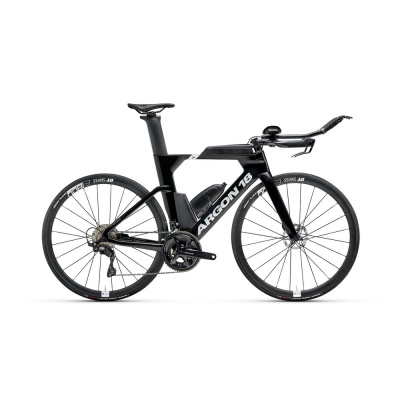
Three distinct models cover most of what you'll need, and understanding where each one sits saves you from buying the wrong tool. The E-119 Tri+ is Argon 18's flagship non-UCI legal triathlon bike - fully integrated, deeply aero, and designed around race-day self-sufficiency. It carries onboard hydration and nutrition storage built directly into the cockpit and frame rather than bolted on as an afterthought. If you're targeting a full or half-distance event where you need fuel within reach and every watt of aerodynamic efficiency you can find, this is the one. It is not legal for massed-start road events or UCI-regulated time trials, which is worth knowing before you enter a National Championship TT.
The E-118 Tri+ fills the gap between those two worlds. It's Argon 18's UCI-legal time trial machine, which makes it eligible for CTT-affiliated events and sanctioned road races. The geometry is aggressive - this is a bike you hold in a tuck position, not one you sit up on when the road kicks - but the integration is trimmed back to comply with the rules. Riders competing across both road TTs and non-drafting triathlons sometimes run this as their one-bike solution.
Then there's the E-117 Tri. Less integrated, more conventional in its componentry, and genuinely easier to travel with. Standard brake mounts and off-the-shelf bar and stem options mean you can swap parts without specialist tools or proprietary replacements. For anyone flying to European or overseas races with a bike box, that's not a small consideration. It's also the natural entry point if you're stepping up from an Argon 18 road bike and want a proper TT position without committing to full flagship-level integration.
What the Argon 18 Tech Actually Does
The 3D System is the piece of Argon 18 engineering that gets discussed most, and rightly so. It's a structural headtube extension system that lets you adjust handlebar stack height without piling standard alloy spacers under the stem. That matters because conventional spacers introduce flex into the front end - stack them high enough and you can feel the steering go vague under hard efforts. The 3D System keeps the structural integrity intact across a much wider range of positions. Practically, it means a shorter rider and a taller rider can both find a legal, stiff, precise setup on the same frame platform without compromise.
The ONEness Concept takes that integration philosophy further across the whole cockpit. Bars, extensions, computer mount, hydration, and cables are treated as a single aero unit rather than a collection of parts strapped together. The result is a cleaner frontal profile and fewer turbulent edges for the air to catch. It also looks purposeful in a way that zero-effort, cable-tie-and-bottle-cage approaches simply don't.
On the E-119, the hidden disc brake calipers are integrated into the fork and frame rather than exposed to the airstream. Disc brakes on a TT or triathlon bike were once frowned upon for the aerodynamic drag they introduced, but Argon 18's approach addresses that directly. You get the braking reliability of a hydraulic disc system - genuinely useful in wet UK conditions - without the aerodynamic penalty of a caliper sitting proud in the wind. The Pro 3.0 Carbon Layup runs through the flagship models, tuning stiffness and compliance by varying fibre orientation and laminate thickness across the frame. It's not one-spec-fits-all carbon; the layup changes by zone depending on whether the priority is power transfer, vibration damping, or torsional rigidity.
If you're comparing at this level, Cervélo TT & Triathlon bikes and Felt TT & Triathlon bikes offer their own integration approaches, but the 3D System's fit range and the ONEness cockpit's aerodynamic coherence are genuinely distinctive features rather than rebranded industry norms.
Running an Argon 18 on UK Roads
British TT courses aren't always kind to aero bikes. Exposed dual carriageways and A-road out-and-back courses can throw crosswinds at you from angles that test front-end stability, and the E-119's fully integrated cockpit does give you a planted, predictable feel because the front end isn't moving around in the way a loosely assembled cockpit can. That said, deep-section wheel choice matters as much as the frame here - pair a nervous front wheel with any TT bike and you'll be fighting it.
Tyre clearance up to 28c is a genuine practical win on UK chip-seal. Plenty of British B-roads have surfaces that would vibrate fillings loose on a 23c tyre at race pressure. Running a 25c or 28c at sensible pressure turns a punishing surface into something manageable, and Argon 18's clearance figures allow that without frame rub. It's the sort of detail that doesn't show up in wind tunnel data but absolutely shows up in your legs over 40km.
Disc brakes are now standard on the flagship Argon 18 models, and if you've raced a wet early-season triathlon or a March CTT event in the UK, you'll know why that matters. Rim brake performance in the wet - especially on carbon rims - is a variable you'd rather not be thinking about mid-descent. Hydraulic discs give you consistent, modulated stopping regardless of whether it's been raining since Dorridge. Maintenance on disc setups is straightforward: keep the rotors clean, bleed the system annually or when the lever feel changes, and check pad wear after a gritty season. BMC TT & Triathlon bikes take a similar approach to disc integration at the top of their range, so the servicing principles carry across if you're familiar with that platform.
One honest trade-off: the E-119's full integration makes improvised roadside repairs harder. If a proprietary bar section or integrated hydration unit fails mid-race, you're not fixing it with a multi-tool. The E-117's conventional componentry is more forgiving in that scenario, which is part of why it suits riders who travel frequently or want more flexibility in their build options.
Argon 18 Time Trial & Triathlon Bikes FAQs
Are Argon 18 bikes good for triathlon?
Very much so. Argon 18 has been ridden to multiple Ironman wins and the E-119 Tri+ is designed specifically for non-drafting long-distance events. Integrated hydration, a cockpit built around aero efficiency, and fit adjustability across a wide range of rider positions make it a serious choice at every level of the sport.
What is the difference between the Argon 18 E-117 and E-119?
The E-119 is the flagship triathlon superbike - fully integrated hydration and nutrition storage, hidden disc brake calipers, and the ONEness cockpit system. It's non-UCI legal. The E-117 uses standard components, making it far easier to travel with and maintain, and it's the more accessible entry point into the Argon 18 TT range.
What is the Argon 18 3D System?
It's Argon 18's proprietary headtube extension technology. Instead of stacking standard spacers to raise handlebar height - which introduces flex and reduces steering precision - the 3D System uses structural extensions that maintain front-end stiffness across a wide range of stack heights. Fit flexibility without the handling compromise.