
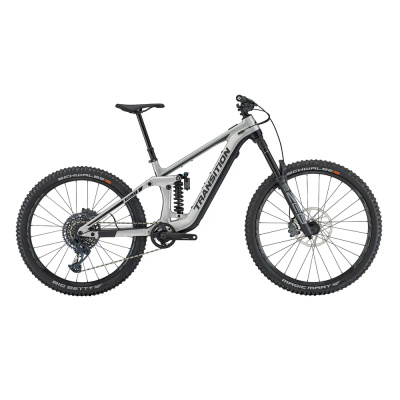
Transition Relay PNW Alloy
An aluminium 170 mm eMTB with Fazua Ride 60 assistance, a removable 430 Wh battery and Eagle 90 kit for aggressive trail and enduro riding.
- Fazua Ride 60: 60 Nm of help that still leaves you pedalling, then decouples past the assist limit.
- Removable battery: Charge the 430 Wh pack indoors, or leave it out and ride without motor support.
- 170 mm coil setup: ZEB Select+ and Vivid Coil travel for steep, fast descents.
- Mixed-wheel layout: 29-inch front and 27.5-inch rear from S to XXL. XS runs 27.5-inch wheels both ends.
- Eagle 90 Transmission: Mechanical 1x12 with a 10-52t range and no derailleur battery.
- Maven Bronze brakes: Strong stopping, with a 220 mm front rotor from S and 200 mm rotors on XS.
Transition Relay PNW Alloy Deals

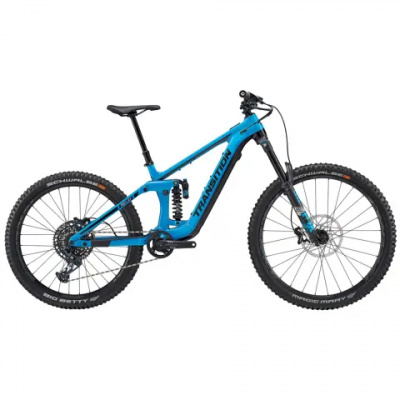
Prices and availability can change quickly. Delivery charges are not always included in listed prices.
Final price, stock status and delivery terms are set by retailer. We may receive a commission on purchases made.
Bikesy's Verdict
Riders who like a long climb and a descent they can really attack are the ones the Transition Relay PNW Alloy is for. The Eagle 90 build wraps 170 mm of RockShox travel, a coil shock and Maven brakes around 60 Nm of Fazua Ride 60 assistance, and the battery can live in the house between rides or stay at home when you want the motor out of the equation. Lifting is the part to take seriously: 22.63 kg in size M with the battery, 20.36 kg without. The 430 Wh pack also needs a planned route, because a plug-in extender is not part of the deal. For confident trail and enduro riding, that mix of a motor that stays in the background and suspension that can take a proper descent is a strong reason to own one.
Pros
- Battery out without tools, so you can charge indoors or pedal with the motor decoupled.
- 170 mm ZEB, Vivid Coil, Maven brakes and Super Trail tyres make a proper descending package.
- Eagle 90 Transmission is mechanical and rebuildable, with no derailleur battery to charge.
- The frame can be set to 160 mm or 170 mm, and to either rear wheel size, if the matching parts are changed together.
- XS riders get dual 27.5-inch wheels, shorter cranks, smaller rotors and a shorter dropper.
Cons
- A size M is 22.63 kg with the battery and 20.36 kg without, so lifting, racks and unassisted climbs all feel like a big bike.
- The 430 Wh battery has no plug-in extender, so long or high-assist days need a tighter route plan.
- On smoother, easier trails the 170 mm coil setup can feel muted compared with a shorter-travel bike.
You know the ride: a long climb to earn a descent that is steep, loose and properly fast. The Transition Relay PNW Alloy is an alloy eMTB for that kind of day, with Fazua Ride 60 assistance rather than a full-power motor doing the pedalling for you. You still put the work in on the way up. On the way down, 170 mm of travel and a slack front end are there so you can commit.
Confident intermediate and advanced riders will get the most from it, especially on loops that stack technical descents after a long climb, or on self-shuttled laps where the motor saves some uplift time. Indoor charging, and the odd ride with the battery left at home, are part of the appeal. Maximum assistance for minimum effort is a different kind of electric bike. So is a week of mellow trails, where 170 mm and a coil are more bike than the riding needs.
Compare Transition Relay PNW Alloy prices and offers
The Eagle 90 build is the current UK model. Transition's official UK RRP for the Relay PNW Alloy Eagle 90 is £6,999.
An original UK RRP of £7,999.95 belongs to the earlier GX package. That figure sits with a different set of suspension, brakes, wheels and gears, so it describes the older build rather than this Eagle 90 specification.
What is the current Transition Relay PNW Alloy?
Shifting on the Eagle 90 build is mechanical SRAM Eagle 90 Transmission, a 1x12 with a 10-52t cassette and a single-click shifter. The derailleur is Full Mount, so it bolts to the frame's SRAM UDH interface instead of a traditional hanger. Links, skid plates and the cage are replaceable, which matters when a rock finds the mech. You still have a gear cable to look after in the wet. You don't have a derailleur battery to forget. A later AXS conversion is possible if you add matching Transmission parts, AXS controls and a derailleur battery. That isn't how the bike arrives.
RockShox supplies the suspension: a ZEB Select+ fork and a Vivid Coil Select+ shock, both at 170 mm. The shock is a 205 mm x 65 mm trunnion. Brakes are SRAM Maven Bronze, with 220 mm front and 200 mm rear rotors from S to XXL, and 200 mm both ends on XS. Wheels are DT Swiss E 1900 Spline 30, with a Schwalbe Magic Mary Super Trail Soft 2.4 up front and a Big Betty in the same construction out back. Put together, it is a coherent descending kit rather than a trail bike with a long fork bolted on.
Transition publishes 22.63 kg for a size M with the battery fitted, and 20.36 kg with it removed. Those figures are for size M only. Use them when you are checking a car-rack limit, or working out whether you can lift the bike onto that rack and up the stairs at home.
The bar is an 800 mm ANVL Mandrel, the stem a 40 mm ANVL Swage, and the dropper a OneUp unit running from 120 mm on XS to 240 mm on XL and XXL. Rise, crank length and rotors also change with size, so the right row for your frame matters more than a single model-wide guess.
Relay PNW frame, geometry and likely ride character
This bike and the standard Relay share an aluminium frame. The factory Relay setup is 160 mm, normally with a 29-inch rear wheel. Relay PNW is the 170 mm version with a 27.5-inch rear wheel, and the lower flip chip accounts for that smaller wheel. Against the current 160 mm Relay Carbon Eagle 90, this alloy PNW is the more aggressive travel setup, and its official UK price is lower.
You can move the frame between those setups later, but only with the matching wheel, an approved 160 mm or 170 mm fork, and the right shock stroke: 205 mm x 65 mm for 170 mm of travel, or 205 mm x 60 mm for 160 mm. An air shock in the right size is a supported swap if you would rather change spring rate with a pump. The chip on its own doesn't do the job. A dual-crown fork isn't approved.
Sizes S to XXL make this a mixed-wheel eMTB, 29-inch at the front and 27.5-inch at the rear. XS isn't a mullet. It runs 27.5-inch wheels both ends, with a 37 mm fork offset and a 568 mm axle-to-crown, where the other sizes use 44 mm of offset and 588 mm. Buy the XS as that small-wheel package, not as a mixed-wheel bike with a different badge.
Speed Balanced Geometry is drawn around the stock 40 mm stem. Head angle is 63.6 degrees on XS, 63.3 degrees on S, M and L, and 63.4 degrees on XL and XXL. Reach runs from 405 mm to 527 mm, and the wheelbase from 1172 mm to 1341 mm. Effective seat angles are steep, 79.3 degrees on XS down to 76.3 degrees on XXL, which is what holds you over the pedals on a seated climb. Actual seat tube angle is published between 70.3 and 70.6 degrees depending on size, so a gauge on the tube won't match the effective number. Expect calm steering once you are moving. The smaller rear wheel helps the bike change direction. The length and the slack front end still want a committed line.
GiddyUp is the linkage, progressive enough for a coil and still able to offer support and traction when the descent gets rough. The stock Vivid Coil should take the sting out of repeated hits. On smoother trails the same setup can feel muted, swallowing the small feedback a shorter-travel bike would leave in your hands. A 99 Spokes ride of a carbon PNW with an X0 AXS build, not this alloy kit, found the chassis extremely composed on steep, fast ground, and less engaging on smaller features unless ridden hard.
Climbing should be manageable rather than effortless. You have 60 Nm, a steep effective seat angle and a rear wheel that can sit and grip, and you will still be working. The Ride 60 is rated at 250 W continuous and 450 W at the Boost peak, then it decouples above the assistance limit so the pedals aren't dragging once the motor stops helping. Riders stepping off a full-power eMTB will feel the slower pace. Riders who want a mountain bike that happens to have a motor will feel at home.
UK maintenance, battery care and wet-weather ownership
The battery is a removable Fazua Energy 430, published at 430 Wh, and it has to come out of the frame to charge. Transition's time for a full charge on the supplied 3 A charger is about 3.5 hours. Handy if the bike lives in a shed with no socket, as long as you wipe the pack and the contacts before it comes indoors after a muddy ride. Keep those magnetic interfaces clear of metallic grit.
Riding with the battery removed is part of the design, not a workaround. It lifts out without tools, and the drive decouples so you aren't fighting a locked motor. On the current size M you are still on a 20.36 kg bike, which is a lot beside a normal enduro bike, and a better prospect than hauling the full 22.63 kg when the day doesn't need the motor.
No plug-in range extender is supported. High assist, cold, mud and a climb that doesn't ease off will all use the 430 Wh faster, so tailoring support in the app and planning the route matter here. A second main battery is the practical way to add range. Fazua also documents a possible replacement Energy 480 for compatible removable Energy 430 flat-bar systems, after a firmware update. Confirm that it applies to this complete bike before you budget for it.
Some battery doors have alignment marks that may not show the locked position. Turn the latch the way the fitting guide shows, then give the door a gentle pull so you know it is actually shut.
The Eagle 90 cable still wants a look after wet rides, even though you have escaped a shifter battery. Rear tyre clearance is published up to 27.5 x 2.6 inches, and that is a guideline. Leave room for UK mud, and watch for frame rub if you go fatter than the stock 2.4s. Cables are reached through the battery opening, which is at least a straightforward place to start when something needs replacing.
A normal bottle fits from M to XXL. XS and S are set up for a 450 ml Fidlock bottle and may need an adapter. There is also a gear mount under the top tube.
Fazua firmware is part of living with the motor, and some diagnostics need a dealer who can talk to the system. The frame is covered for life against manufacturing defects for the registered original owner. Transition states that Fazua supplies a two-year warranty on the drive unit and battery.
What changed from the Relay PNW Alloy GX build?
The Relay PNW Alloy GX is an earlier build on the same Relay Alloy platform, which Transition covers from 2023 to 2026. It isn't a different frame. The motor was already the Fazua Ride 60 with the removable Energy 430, and the tyres were already Magic Mary and Big Betty Super Trail Soft 2.4s. Its original UK RRP was £7,999.95.
Transition's 2023 GX specification is the package most people will be weighing against a newer bike:
- SRAM GX Eagle cable shifting and a 10-52t cassette, rather than Eagle 90 Transmission
- Fox 38 Performance Elite fork and Fox DHX Factory coil, 205 mm x 65 mm
- TRP DH-R EVO brakes with 223 mm front and 203 mm rear rotors
- RaceFace Aeffect R wheels and Praxis Alloy ETOR cranks, 160 mm on XS and 165 mm from S up
A later GX suspension setup from Transition refers to a ZEB Select+ and a Vivid Coil Select+, so on an older GX bike, trust the fork and shock fitted to that frame rather than assuming every GX package left with Fox. Dropper travel wasn't published for the GX build, so don't copy the Eagle 90 dropper chart across. The frame, the flip chip, the removable battery and the 170 mm PNW idea are what the two builds share. Read the Eagle 90 figures when you are buying this specification new.
Pick the Transition Relay PNW Alloy when the descents are why you go, and you still want a say in the climb. Charge the battery at home, fit it for the hills, and take it out when you would rather just pedal. Owning one means help when you want it, and a bike you can still ride once the pack is sitting in the kitchen.
Key Features & Benefits
- GiddyUp, and a shock you can change: Progression that suits the stock Vivid Coil on rough descents, plus a supported path to a 205 mm air shock if you want spring-rate changes with a pump.
- Battery in, or battery out: Tool-free removal and a drive that decouples. Charge indoors, or ride a size M at 20.36 kg instead of 22.63 kg when you don't need the motor.
- Same frame as the 160 mm Relay: PNW is the 170 mm, 27.5-inch-rear setup. A later change to 160 mm or a 29-inch rear wheel needs the matching wheel, fork and shock stroke together.
- Touchpoints that change with size: Bar rise, dropper travel, cranks and rotors are specified size by size. XS also gets a shorter fork offset and 27.5-inch wheels front and rear.
- A mech you can rebuild: Eagle 90's Full Mount derailleur has replaceable links, skid plates and a cage, and a later AXS conversion stays open if you add the electronic parts.
Geometry
PNW geometry by size
Figures are for the PNW configuration. Effective seat angle is the pedalling-position figure. Actual seat tube angle is the angle of the tube itself.
| Size | Wheels | Reach (mm) | Stack (mm) | Effective top tube (mm) | Head angle (degrees) | Effective seat angle (degrees) | Actual seat tube angle (degrees) | Chainstay (mm) | Wheelbase (mm) | Seat tube length (mm) | Head tube length (mm) | BB drop (mm) | Estimated BB height (mm) |
|---|---|---|---|---|---|---|---|---|---|---|---|---|---|
| XS | 27.5-inch front / 27.5-inch rear | 405 | 593 | 532 | 63.6 | 79.3 | 70.6 | 436 | 1172 | 410 | 105 | 11 | 343 |
| S | 29-inch front / 27.5-inch rear | 422 | 620 | 564 | 63.3 | 78.4 | 70.3 | 440 | 1211 | 410 | 105 | 25 | 350 |
| M | 29-inch front / 27.5-inch rear | 452 | 634 | 597 | 63.3 | 77.7 | 70.3 | 440 | 1247 | 410 | 115 | 25 | 350 |
| L | 29-inch front / 27.5-inch rear | 477 | 643 | 631 | 63.3 | 77.1 | 70.3 | 446 | 1282 | 430 | 125 | 25 | 350 |
| XL | 29-inch front / 27.5-inch rear | 502 | 652 | 665 | 63.4 | 76.6 | 70.3 | 446 | 1312 | 460 | 135 | 25 | 350 |
| XXL | 29-inch front / 27.5-inch rear | 527 | 661 | 696 | 63.4 | 76.3 | 70.4 | 446 | 1341 | 490 | 145 | 25 | 350 |
Alternatives to Consider
The Orbea Rise LT H20 is an aluminium lightweight-assist eMTB with 160 mm up front, 150 mm at the rear and 29-inch wheels both ends. It uses a Shimano system and an internal battery, in a choice of 420 Wh or 630 Wh. The 630 Wh option stores more than the Relay's 430 Wh pack; the 420 Wh option stores less. Neither battery comes out for charging or for riding without it. The Relay PNW answers with 170 mm at both ends, a 27.5-inch rear wheel from size S upwards, and a pack that lifts out without tools.
Trek's Fuel EXe is positioned as a natural-assist trail bike, with a 160 Wh range extender available. Published figures give it a 65-degree head angle and a 77-degree seat angle. The Relay PNW head angle is 63.3 to 63.6 degrees depending on size, and the bike is built around 170 mm of travel for steep, technical descending rather than around topping up range on the move. No plug-in extender is offered on the Relay.
Reviews
Josh Kirchhoff rode a carbon Relay PNW with an X0 AXS build for 99 Spokes, on the first-generation PNW platform rather than this alloy Eagle 90 kit. He found the chassis extremely composed on steep, fast and technical ground, and less engaging on small and moderate trail features unless he pushed it. Useful if you want a sense of how the long-travel PNW layout behaves when the trail gets serious, and when it asks to be ridden hard before it comes alive.
Women's MTB Network tested a size Small Relay PNW Alloy from the earlier component period. That test looks at small-frame fit, battery removal, climbing, descending and Fazua operation. Take it as a look at this alloy frame and the motor system, not as a report on the Eagle 90 fork, shock, brakes or gears.
Full Specification
Shared Relay PNW frame
Frame details shared by the Relay PNW Alloy, rather than unique to the Eagle 90 parts kit.
| Detail | Specification |
|---|---|
| Frame | Aluminium full-suspension frame shared with the standard Relay, lower-shock-mount flip chip, GiddyUp suspension |
| Intended use | Aggressive trail and enduro eMTB riding. Not approved for a dual-crown fork |
| Travel | 170 mm front and rear in the PNW configuration. 205 mm x 65 mm trunnion shock. Air and coil shocks supported. Frame can be configured for 160 mm rear travel with a 205 mm x 60 mm shock |
| Geometry | Speed Balanced Geometry with a 40 mm stem. Reach, stack, effective seat angle and wheelbase are size-specific. XS has a smaller front wheel and reduced fork offset |
| Wheels and tyre clearance | S-XXL: 29-inch front and 27.5-inch rear. XS: 27.5-inch front and rear. Rear tyre guidance up to 27.5 x 2.6 inches, subject to measured clearance |
| Axles, headset and routing | 12 mm x 148 mm Boost rear axle, SRAM UDH, Fazua Ride 60 system interface, 56/66 mm zero-stack headset, internal routing accessed through the battery opening |
| Mounts | Under-top-tube gear mount. M-XXL fit a normal bottle. XS and S use a 450 ml Fidlock bottle and may need an adapter |
Relay PNW Alloy Eagle 90
| Component | Specification |
|---|---|
| Official UK RRP | £6,999 |
| Frame | Relay Alloy, 170 mm rear travel |
| Fork | RockShox ZEB Select+, 170 mm |
| Shock | RockShox Vivid Coil Select+, 205 mm x 65 mm |
| Motor | Fazua Ride 60, 60 Nm, 250 W continuous, 450 W peak Boost |
| Battery | Removable Fazua Energy 430, 430 Wh |
| Shifter | SRAM Eagle 90 MMX Single Click |
| Rear derailleur | SRAM Eagle 90 mechanical Full Mount |
| Crankset | RaceFace Aeffect ETOR; 160 mm XS, 165 mm S-XXL |
| Bottom bracket | Fazua Ride 60 system-specific interface |
| Cassette | SRAM XS-1275, 10-52t |
| Chain | SRAM GX Eagle Transmission |
| Brakes | SRAM Maven Bronze levers and calipers |
| Rotors | SRAM Centerline; 200/200 mm XS, 220/200 mm S-XXL |
| Rims | DT Swiss E 1900 Spline 30 |
| Hubs | DT Swiss 370 Ratchet LN, front and rear |
| Spokes | DT Swiss Champion |
| Tyres | Schwalbe Magic Mary Super Trail Soft 2.4 front; Schwalbe Big Betty Super Trail Soft 2.4 rear |
| Handlebar | ANVL Mandrel Alloy 35, 800 mm; 20 mm rise XS/S, 30 mm M, 40 mm L/XL/XXL |
| Stem | ANVL Swage, 40 mm |
| Headset | FSA No.55R |
| Grips | ODI Elite Flow Lock-On |
| Seatpost | OneUp Dropper; 120 mm XS, 150 mm S, 190 mm M, 210 mm L, 240 mm XL/XXL |
| Saddle | SDG Bel Air 3 |
| Claimed weight | 22.63 kg in size M with the battery; 20.36 kg in size M without it |
Eagle 90 size-by-size fitment
Every size runs 170 mm front and rear, a RockShox Vivid Coil Select+ 205 mm x 65 mm shock, a 40 mm stem, an 800 mm handlebar and the lower flip chip set for the 27.5-inch rear wheel. The table shows what actually changes.
| Size | Wheels | Dropper | Crank | Bar rise | Front rotor | Rear rotor | Fork offset | Fork axle-to-crown | Max seatpost insertion |
|---|---|---|---|---|---|---|---|---|---|
| XS | 27.5-inch front / 27.5-inch rear | 120 mm | 160 mm | 20 mm | 200 mm | 200 mm | 37 mm | 568 mm | 230 mm |
| S | 29-inch front / 27.5-inch rear | 150 mm | 165 mm | 20 mm | 220 mm | 200 mm | 44 mm | 588 mm | 230 mm |
| M | 29-inch front / 27.5-inch rear | 190 mm | 165 mm | 30 mm | 220 mm | 200 mm | 44 mm | 588 mm | 230 mm |
| L | 29-inch front / 27.5-inch rear | 210 mm | 165 mm | 40 mm | 220 mm | 200 mm | 44 mm | 588 mm | 250 mm |
| XL | 29-inch front / 27.5-inch rear | 240 mm | 165 mm | 40 mm | 220 mm | 200 mm | 44 mm | 588 mm | 280 mm |
| XXL | 29-inch front / 27.5-inch rear | 240 mm | 165 mm | 40 mm | 220 mm | 200 mm | 44 mm | 588 mm | 310 mm |