
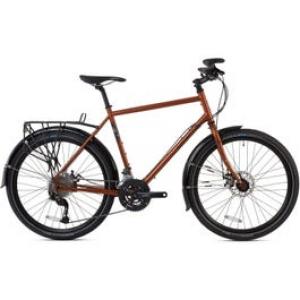
Ridgeback Expedition
Carry your world across continents with bombproof steel comfort, granny gears that laugh at loaded climbs, and tyres that refuse to puncture.
- Reynolds 520 steel frame: soaks up road buzz for all-day comfort
- 48-36-26T triple chainset: 19-inch bottom gear conquers loaded climbs
- Schwalbe Marathon tyres: puncture-proof reliability across continents
- Mechanical disc brakes: consistent stopping, field-repairable anywhere
- Ample rack and bottle mounts: carry everything you need
- 26-inch wheels: robust, tyres available worldwide
Ridgeback Expedition Deals

Prices and availability can change quickly. Delivery charges are not always included in listed prices.
Final price, stock status and delivery terms are set by retailer. We may receive a commission on purchases made.
Bikesy's Verdict
The Ridgeback Expedition is a proper expedition bike - no marketing fluff, just proven steel tubing, bombproof components, and a geometry that prioritises getting you there over getting you there fast. If you're planning a multi-week tour, a year-round commute through British weather, or a bikepacking adventure where reliability trumps weight, this is one of the most sensible choices you can make without spending a fortune.
Reynolds 520 steel gives you the comfort and durability that aluminium can't match at this price, while the 19-inch bottom gear and Schwalbe Marathons mean you'll tackle loaded climbs and rough surfaces with confidence. Yes, it's heavy, and yes, the mechanical discs won't thrill riders used to hydraulic bite - but those are trade-offs that make sense when you're prioritising field repairability and all-day comfort over Strava times. Load it up, point it at a horizon, and it'll get you there with fewer dramas than bikes costing twice as much.
Pros
- Reynolds 520 steel frame delivers genuine all-day comfort and durability
- 19-inch bottom gear makes loaded climbing manageable on steep gradients
- Schwalbe Marathon tyres offer exceptional puncture resistance and longevity
- Mechanical disc brakes stay reliable and field-repairable anywhere
- Abundant rack, mudguard, and bottle mounts suit serious touring
- 26-inch wheels ensure tyre availability worldwide and robust load-carrying
Cons
- Over 14kg before luggage - heavier than lighter touring or hybrid options if you're not carrying loads
- Mechanical disc brakes lack the power and modulation of hydraulics if you're used to high-end systems
- Stock saddle and pedals are basic; most riders will want to upgrade for comfort and efficiency
About the Ridgeback Expedition
The Ridgeback Expedition doesn't pretend to be anything other than what its name promises: a steel-framed workhorse built to haul your kit from Land's End to John o'Groats, or further if you're feeling ambitious. Reynolds 520 chromoly tubing forms the backbone, TIG-welded with an open gusset under the down tube where the head tube takes the brunt of loaded steering forces. It's old-school engineering done right - no carbon whispers or aero claims, just proven metallurgy that flexes enough to smooth out corrugated tarmac yet stays taut when you've strapped twenty kilos of panniers to the rear rack.
That rack-ready philosophy runs through every tube and boss. Three bottle cage mounts climb the down tube and seat tube, low-rider fork bosses let you spread the load forward, and there's even a pump peg and kickstand plate for the practical touches that matter when you're miles from the nearest bike shop. The 26-inch wheels might raise eyebrows in an era of rolling-faster 700c hoops, but they're a deliberate nod to global tyre availability and the ability to fit lower gearing - crucial when you're grinding up a 15% gradient in the Highlands with a week's worth of camping gear swaying behind you. Schwalbe Marathon rubber wraps those rims, the tyre equivalent of a Land Rover: heavy, slow to accelerate, utterly unstoppable.
Mechanical disc brakes anchor each wheel with Promax DSK-300 callipers and Shimano Deore levers. They won't win modulation awards against hydraulic setups, but you can true a rotor with a spanner and bleed them with a cable cutter - handy when the nearest bike mechanic is three countries away. The cockpit sits you upright via a positive-rise stem and 620mm riser bars (640mm on larger frames), with ergonomic grips that sprout integrated bar ends for shifting hand positions on long hauls. It's a posture that prioritises seeing the road and easing your lower back over chasing Strava segments, and after eight hours in the saddle you'll understand why.
Ridgeback Expedition geometry
Touring geometry is all about stability under load, and the Expedition leans into that brief with a longer wheelbase and relaxed angles that keep the front end calm when panniers start swinging. The head angle sits back enough to resist twitchy steering inputs - useful when a gust catches your front bags or you're navigating a rutted track one-handed while checking a map. Chainstays stretch long to clear heel strike on loaded rear racks and to plant the back wheel firmly, so the bike tracks straight rather than wagging its tail when you stand to climb.
Reach and stack figures favour an upright torso, reducing strain on wrists and shoulders during multi-day efforts. The bottom bracket drops low, lowering your centre of gravity and adding to that planted, confidence-inspiring feel when the road turns to gravel or you're descending a switchback with forty kilos aboard. It's not a bike that carves tight corners or flicks through traffic; it's one that holds a line, absorbs bumps, and lets you settle into a rhythm that eats miles without drama.
Component choices & upgrades
The stock build is already well sorted for its intended role. Shimano Alivio shifters and derailleurs handle the 27-speed drivetrain - a 48-36-26T triple up front paired with an 11-36T cassette out back - delivering a bottom gear low enough to spin up almost anything without unclipping. That 19-inch low gear is a gift when you're loaded and the gradient kicks double-digits. The KMC X9 chain and Shimano BB-ES300 square-taper bottom bracket are straightforward, serviceable pieces that any mechanic worldwide can fettle.
Jalco DM25 double-wall rims laced to Shimano M475 cup-and-cone hubs with 36 spokes per wheel offer durability over outright lightness. Those hubs need periodic adjustment and greasing, but they're rebuildable and parts are ubiquitous. If you're chasing marginal gains or planning truly remote routes, consider swapping to sealed-bearing hubs for lower maintenance, though you'll sacrifice some serviceability. The Schwalbe Marathons are near-perfect for the job - reflective sidewalls, puncture-resistant casing, long tread life - but if you're tackling more aggressive gravel or bikepacking singletrack, a switch to something like a Marathon Mondial or even a Schwalbe G-One Overland (if clearance allows) adds grip without sacrificing too much durability.
The Ridgeback-branded saddle and basic FPD road pedals with toe clips are functional starting points, but saddles are personal and pedals are cheap upgrades. If you're logging serious miles, invest in a perch that suits your sit bones and consider SPD pedals for efficiency - though many tourers prefer flats for walking around campsites. The mechanical disc brakes work well enough, but if you're confident with cable routing and want more power, aftermarket callipers like TRP Spyre or Spyke offer better modulation while staying cable-actuated. Hydraulic conversions are possible but undermine the field-repair simplicity that makes mechanicals appealing for expedition work.
Where the Ridgeback Expedition excels
This bike is outstanding at one thing: carrying you and your luggage across long distances on mixed surfaces without complaint. Load it with panniers, a bar bag, and a saddlebag, point it at a horizon, and it'll get you there with a ride quality that stays comfortable when tarmac turns to chipseal or a bridleway detour appears. The upright position and wide gearing make it equally at home on a daily commute through wet city streets - where the full mudguards and reliable brakes shine - or a multi-week tour through the Scottish Highlands.
It handles gravel byways and rough lanes with composure, the steel frame and generous tyre volume soaking up ruts and washboard without rattling your fillings loose. Stability when fully loaded is a standout trait; the long wheelbase and low centre of gravity mean the bike doesn't wander or shimmy even when you're carrying enough kit to camp wild for a fortnight. Climbing with weight is manageable thanks to that granny gear, and descending feels controlled rather than skittish.
Where it's not ideal: fast group rides, technical singletrack, or anything requiring quick handling. The Expedition weighs over 14 kilos before you add luggage, and that mass combined with touring geometry means it accelerates slowly and corners deliberately. If you're after a nimble bike for weekend club runs or a lightweight machine for credit-card touring, look elsewhere. It's also overkill for short urban commutes where a lighter hybrid would suffice, though the durability and weather protection still make it a sensible choice if you ride year-round in all conditions.
Ridgeback Expedition FAQs
What is the best tyre clearance on a Ridgeback Expedition?
Clearance is generous - older reviews describe it as "massive" - and the frame comfortably swallows the stock 26 x 1.75" Marathons with room for mudguards. You could fit wider rubber, potentially up to 2.0" or slightly beyond, depending on mudguard and rack fitment, making it flexible for different terrain demands.
Is the Ridgeback Expedition suitable for bikepacking?
Absolutely. The frame's abundant mounts, stable geometry, and durable build make it a natural for bikepacking, whether you're using traditional panniers or modern frame bags and saddlebags. The low gearing and comfortable ride position suit long days on mixed surfaces, and the mechanical disc brakes and rebuildable hubs offer peace of mind in remote areas.
How does the Ridgeback Expedition handle fully loaded?
It handles loaded weight with calm authority. The long wheelbase and low bottom bracket keep the centre of gravity planted, so the bike tracks straight and descends confidently even with forty-plus kilos aboard. Steering stays predictable rather than vague, and the steel frame's compliance prevents harsh feedback from reaching your hands when the road deteriorates.
What are the differences between Ridgeback Expedition and Panorama models?
The Panorama is typically positioned as a slightly less rugged touring option, often with a lighter build and fewer expedition-specific features like low-rider fork mounts or as wide a gear range. The Expedition prioritises load-carrying capability and durability for serious multi-day tours, while the Panorama leans towards lighter recreational touring and commuting.
Can I fit hydraulic disc brakes to a Ridgeback Expedition?
Technically yes - the frame and fork have standard post-mount or flat-mount brake tabs - but doing so sacrifices the field-repair simplicity that makes mechanical discs appealing for remote touring. If you want better modulation while staying cable-actuated, higher-quality mechanical callipers like TRP Spyre are a smarter upgrade that preserves the expedition ethos.
What is the weight limit for the rear rack on a Ridgeback Expedition?
Specific weight limits aren't published in the available research, but the frame's robust steel construction and dedicated rack mounts are designed to handle typical touring loads - generally 20 - 25 kilos on a rear rack is standard for bikes of this type. Always check the rack manufacturer's own rating and distribute weight sensibly between front and rear to maintain handling balance.
Is the steel frame of the Ridgeback Expedition comfortable for long rides?
Very much so. Reynolds 520 chromoly steel has natural vibration-damping properties that smooth out road buzz and chatter, reducing fatigue over long distances. Combined with the upright riding position, generous tyre volume, and forgiving geometry, the Expedition delivers all-day comfort that aluminium or carbon frames in this price bracket struggle to match.
What kind of maintenance is required for the Shimano M475 hubs?
The M475 hubs use cup-and-cone bearings, which require periodic adjustment to eliminate play and occasional disassembly for cleaning and re-greasing - typically once or twice a year depending on mileage and conditions. It's straightforward work with cone spanners and grease, and parts are widely available, making them ideal for long-term touring where you might need to service them on the road.
Key Features & Benefits
- Reynolds 520 chromoly steel frame with TIG welding and reinforced gusset: Absorbs road vibration for all-day comfort while staying stiff enough to handle heavy loads without flex
- 48-36-26T triple chainset with 11-36T cassette (19-inch bottom gear): Spin up steep climbs even when fully loaded, without grinding your knees into dust
- Schwalbe Marathon 26 x 1.75" tyres with reflective sidewalls: Shrug off punctures, last thousands of miles, and keep you visible in low light
- Promax DSK-300 mechanical disc brakes with Shimano Deore levers: Consistent stopping power in all weather, repairable with basic tools in remote locations
- Multiple rack, mudguard, and bottle cage mounts including low-rider fork bosses: Carry everything you need for multi-week tours with balanced weight distribution and full weather protection
Ridgeback Expedition 2024, 2023 & earlier differences
The Expedition has remained remarkably consistent across recent model years, with the 2023, 2024, and 2025 specifications showing minimal variation. All three retain the Reynolds 520 steel frame, 26-inch wheels, Shimano Alivio/Deore drivetrain components, Promax DSK-300 mechanical disc brakes, and Schwalbe Marathon tyres. This stability reflects the bike's mature, proven design rather than a lack of development - when a formula works for expedition touring, there's little reason to chase trends.
Earlier iterations saw more significant changes. The 2017 model introduced Shimano hydraulic disc brakes (BR-M315), a shift that some reviewers questioned for expedition use due to the added complexity of bleeding and servicing hydraulics in remote locations. By 2023 the bike had returned to mechanical discs, suggesting Ridgeback listened to feedback from serious tourers who valued simplicity and field repairability. The 2016 model marked a geometry update to a more classic horizontal top-tube design for improved stiffness, and adopted flat handlebars with integrated bar ends - a cockpit layout that has carried through to the current bike. Component tiers have shuffled slightly over the years (Alivio versus Deore for certain parts), but the overall philosophy and capability have remained constant: a durable, comfortable, load-carrying workhorse built to cross continents without fuss.
Alternatives to Consider
Within the Ridgeback range, the Panorama offers a lighter, less expedition-focused touring option if you're planning shorter trips or prioritise a nimbler ride over maximum load capacity. It typically sheds some of the Expedition's burlier fittings and may use slightly racier geometry, making it better suited to recreational touring and fast commuting rather than crossing continents.
Cross-brand, the Trek 520 is a direct rival - another steel tourer with drop bars, a wide gear range, and proven durability, though it leans more traditional in its aesthetic and often commands a higher price. The Kona Sutra similarly targets serious tourers with steel construction and ample mounts, but offers a slightly more modern, adventure-bike vibe and often comes with drop bars as standard. For a British alternative, the Dawes Galaxy has decades of heritage in the touring world, offering classic steel frame comfort and a similar philosophy, though component specs and availability can vary by year. If you're drawn to the bikepacking side of things, the Salsa Marrakesh blends touring capability with off-road confidence via slightly more aggressive geometry and tyre clearance, while the Specialized Sequoia takes a more contemporary approach with disc brakes, wider tyre options, and a frame that bridges gravel and touring disciplines. Each of these alternatives shifts the balance between traditional touring, modern bikepacking, and everyday practicality - the Expedition sits firmly in the expedition-ready camp, prioritising bombproof reliability and load-carrying over weight or speed.
Reviews
Reynolds 520 tubing delivers the kind of ride quality that makes sense after the first full day in the saddle: compliant enough to smooth out patched tarmac and gravel tracks, yet stiff enough laterally that the bike doesn't wag when you're grinding up a 12% pitch with panniers swaying. The frame's open gusset at the head tube junction adds reassurance when steering forces multiply under load, and the TIG welds are clean and confidence-inspiring.
Gearing is where the Expedition truly earns its keep. That 48-36-26T triple paired with an 11-36T cassette gives you a 19-inch bottom gear - low enough to spin up almost any gradient without standing, even when you're carrying a fortnight's camping kit. We've seen loaded tourers tackle Alpine passes and Scottish single-tracks without resorting to walking, and the Shimano Alivio shifters handle the range without fuss. The mechanical disc brakes won't win awards for bite or modulation, but they stop you reliably in the wet and you can true a rotor or replace pads with a multi-tool, which matters more than ultimate power when you're three days from the nearest bike shop.
Schwalbe Marathons are the tyre equivalent of a Swiss Army knife: not the lightest, not the fastest, but they refuse to puncture and they last thousands of miles. Reflective sidewalls add a safety margin in low light, and the 1.75" width offers enough volume to cushion rough surfaces without feeling sluggish on tarmac. When paired with the 26-inch wheels - chosen for global tyre availability and the ability to fit lower gearing - the ride quality stays composed whether you're on chipseal, gravel byways, or potholed urban roads.
Handling is deliberately calm. The long wheelbase and relaxed head angle mean the bike tracks straight and resists twitchy inputs, which becomes a virtue when a crosswind catches your front panniers or you're navigating a rutted descent one-handed. It's not a bike that carves tight corners or accelerates out of junctions with urgency, but that's not the point. Stability under load is exceptional, and the low bottom bracket keeps your centre of gravity planted so the bike feels secure rather than top-heavy even when fully laden. Because the geometry prioritises comfort and control over speed, you settle into a rhythm that eats miles without drama - exactly what you want when the destination is days away, not hours.
Full Specification
| Frame Material | Reynolds 520 Chromoly Steel |
| Fork Material | Steel |
| Wheel Size | 26 inch |
| Tyres | Schwalbe Marathon GG 26 × 1.75" |
| Shifters | Shimano Alivio SL-M3100 |
| Rear Derailleur | Shimano Alivio RD-M3100-SGS |
| Front Derailleur | Shimano Alivio FD-T4000 |
| Crankset | Shimano FC-T4010 48-36-26T |
| Cassette | Shimano CS-HG400 11-36T |
| Chain | KMC X9 |
| Bottom Bracket | Shimano BB-ES300 (Square Taper) |
| Brakes | Promax DSK-300 Mechanical Disc |
| Brake Levers | Shimano Deore |
| Brake Rotors | 160 mm |
| Rims | Jalco DM25, 36-spoke, double-wall |
| Hubs | Shimano M475 |
| Spokes | 14g steel, 36-spoke |
| Handlebar | Ridgeback Alloy Riser, 620 mm (XS - M) / 640 mm (L - XL) |
| Stem | Ridgeback AS-007, 90 mm (XS - M) / 100 mm (L - XL) |
| Grips | Ridgeback Ergonomic with integrated bar ends |
| Headset | Prestine PT-1767D |
| Seatpost | Alloy 27.2 × 350 mm |
| Saddle | Ridgeback Custom |
| Pedals | FPD Road with toe clips |
| Speeds | 27-speed |
| Weight | 14.59 kg |