
Juliana Mountain Bikes
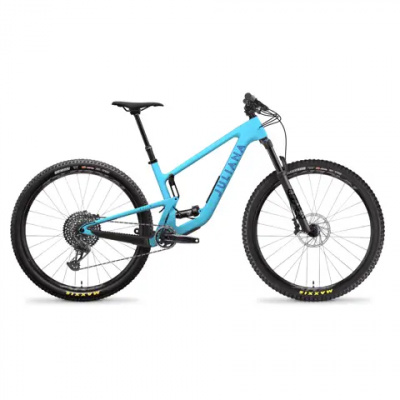
Juliana mountain bikes sit at the top of the women's MTB market - not because they're dressed up in different colours, but because they're genuinely engineered differently. Sharing premium frame moulds with Santa Cruz, Juliana takes proven, race-tested platforms and refines the details that actually matter for lighter riders: custom-tuned shocks, women's specific saddles and grips, and carbon layups that don't ask you to compromise.
The range covers a lot of ground. You've got the Wilder for cross-country and downcountry work, the Joplin as a fast, capable 29er trail bike, the Furtado bringing mixed-wheel mullet playfulness to technical trail riding, and the Roubion at the enduro end of the spectrum. Each one comes in either a C carbon or CC carbon frame, with build kits ranging from solid workhorse specs to full-fat flagship builds.
For UK riders, the appeal is direct. Whether you're threading singletrack in the Tweed Valley, grinding out winter miles in the Peak District, or sessioning the steep stuff in Wales, there's a Juliana that fits the brief - and it'll fit properly, not just nominally.
Prices and availability can change quickly. Delivery charges are not always included in listed prices.
Final price, stock status and delivery terms are set by retailer. We may receive a commission on purchases made.
Decoding the Juliana Lineup
Four bikes, four very different briefs. The Wilder is the lightest and keenest of the bunch - a cross-country and downcountry machine that rewards efficient pedalling and punishes unnecessary weight. If you're chasing lap times or covering big distances, this is your starting point.
Step up in travel and the Joplin enters the picture. It runs 120mm of rear travel on a 29er platform, rolls quickly, and handles trail work without drama. Think of it as the do-everything option - competent on a technical descent, never a chore on the climb back up. The Juliana Furtado vs Roubion question comes up a lot, but the Joplin sits clearly between them in character: more focused than the Furtado, less committed than the Roubion.
The Furtado is where things get interesting. Running a mullet setup - 29-inch front, 27.5-inch rear - it's lighter on its feet than a pure 29er and corners with real enthusiasm. With 130mm of travel, it's built for riders who want to play on the trail rather than just get down it. If your local riding involves tight switchbacks, rooty sections, or anything that rewards a nimble front end, the Furtado earns its keep.
At the far end sits the Roubion: 150mm of rear travel, MX wheel configuration, and enduro intent. Tweed Valley stages, rowdy Welsh descents, anything that demands confidence and composure under load - this is the tool. It's also significantly chunkier than the Furtado, so be clear on what you're buying it for.
On frames, the choice between C carbon and CC carbon layups is straightforward. C is the entry-level carbon construction - still a proper carbon frame, noticeably lighter than aluminium, and more than capable in most conditions. CC is the premium layup, stiffer, lighter, and the one you'll want if you're racing or simply want the best. The weight difference is real. Build kit naming follows a logical hierarchy - R sits at the more accessible end, S steps things up, and GX AXS or X01 builds represent the top of the range. Higher trim levels don't change the frame; they change the components hanging off it.
The Engineering Behind the Ride Feel
Juliana's suspension story starts with VPP - Virtual Pivot Point. It's a dual-link design where the rear triangle pivots around two counter-rotating links, and the geometry of those links is carefully calculated to control how the suspension reacts under pedalling load, braking, and compression. The result is a system with strong mid-stroke support - it doesn't wallow when you're pushing hard - combined with genuine bottom-out resistance when things get rowdy. Compared to a simple single-pivot design, VPP tracks the ground more actively without sacrificing pedalling efficiency.
The lower-link placement is part of what makes VPP work so well on varied ground. It keeps the pivot geometry consistent through the travel and contributes to that planted, confident feel through compressions. Worth knowing, though: lower links do sit closer to the ground, which matters if your riding regularly involves deep mud. More on that shortly.
The detail that genuinely separates Juliana from simply relabelling a Santa Cruz is the custom shock tune. The shocks are specifically valved for lighter riders. That matters more than it might sound. A shock tuned for a heavier rider forces a lighter person to run dangerously low air pressures to access the travel - and even then, the mid-stroke can feel vague. Juliana's tune means the suspension works in the range it's supposed to, at pressures that are actually safe and predictable. You're not fighting the bike to get it to behave.
Proportional geometry rounds out the technical picture. Rather than scaling every dimension linearly, Juliana adjusts chainstay lengths by size so that the handling balance feels consistent whether you're on a small or a large frame. A smaller rider gets a shorter rear end proportionally, keeping the bike manoeuvrable rather than feeling stretched. It's the kind of detail that doesn't show up in a spec sheet but makes a noticeable difference once you're on the bike.
Owning a Juliana in UK Conditions
The lower-link VPP design is excellent for traction, but it does mean the pivots are in the firing line during a Welsh winter or a muddy Peak District loop. Grime accumulates around those lower bearings faster than on a high-pivot layout, and if you're not rinsing the bike after every wet ride, you'll accelerate wear. That said, Santa Cruz - and by extension Juliana - offers a lifetime bearing replacement warranty that covers the cost of new bearings for the life of the frame. For UK riders who ride year-round in all conditions, that's not a minor footnote; it's a genuinely significant ownership benefit. Keep the pivot bolts clean and re-grease them occasionally, and the suspension will stay smooth for a long time.
The MX mullet configuration on the Furtado and Roubion is particularly well-suited to the kind of steep, technical riding you find across the UK's trail centres. A 27.5-inch rear wheel tucks in tighter through compressions and drops, which means less chance of clipping the tyre on steep roll-ins or rutted chutes. The 29-inch front keeps rollover momentum and steering stability. It's not a gimmick on this kind of ground - it's a genuine advantage.
Tyre clearance is generous across the range, which helps when conditions deteriorate. If you're planning serious winter use in the Brecon Beacons or the Scottish Borders, a tyre swap to something more aggressive is straightforward. The frames have room for it.
For riders comparing Juliana to other premium options at this level, Ibis mountain bikes offer similarly refined carbon construction and thoughtful geometry, while Cannondale mountain bikes bring a different flavour of trail performance worth considering if you want to explore the alternatives. At the more accessible end of carbon trail bikes, Cube mountain bikes and Giant mountain bikes represent the value benchmarks that Juliana is priced well above - but then the suspension engineering, carbon quality, and touchpoint refinement are in a different bracket entirely.
One practical note on spec selection: if you're considering a Juliana carbon mountain bike in C spec with a view to upgrading components later, the frame itself won't hold you back. The C layup is entirely capable; you're just carrying a little more weight. Going straight to CC makes more sense if you know you'll be riding hard and want the best dynamic response from the off. A Juliana Joplin review will tell you the same thing - the frame platform is the constant, the build kit is the variable.
Juliana women's MTBs in the UK aren't a niche curio. They're a focused, well-supported range that's genuinely thought through for the riders buying them - and that shows up every time the ground gets complicated.
Juliana Mountain Bikes FAQs
Are Juliana bikes just Santa Cruz bikes?
They share the same premium frame moulds and VPP suspension platforms as Santa Cruz, so the structural engineering is identical. Where Juliana differs is in the custom shock tunes valved for lighter riders, the women's specific touchpoints like saddles and grips, and the colourways. It's the same skeleton, properly set up for a different rider.
What is the difference between the Juliana Furtado and Joplin?
The Joplin is a 29er trail bike with 120mm of rear travel - efficient, quick-rolling, and comfortable covering distance. The Furtado runs 130mm on a mullet wheel setup, prioritising agility and playfulness over outright pace. If you want to cover ground, Joplin. If you want to have fun doing it, Furtado.
Do Juliana bikes have women's specific geometry?
Juliana doesn't alter frame angles specifically for women - they use the same refined geometry as Santa Cruz, which is genuinely well-developed. The women's specific work happens in the suspension kinematics, with custom shock tunes for lighter riders, and in the contact points. Proportional chainstays across sizes keep handling balanced regardless of frame size.