
Factor Time Trial & Triathlon Bikes
Factor Time Trial and Triathlon bikes exist for one reason: to make you faster against the clock. Factor built its reputation through motorsport-influenced engineering and relentless wind-tunnel testing, and that obsession filters directly into how these bikes are designed, shaped, and refined. There's no flab here - every curve and junction has been argued over in CFD software before it ever saw a mould.
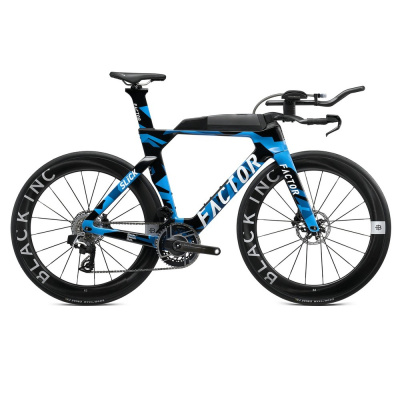
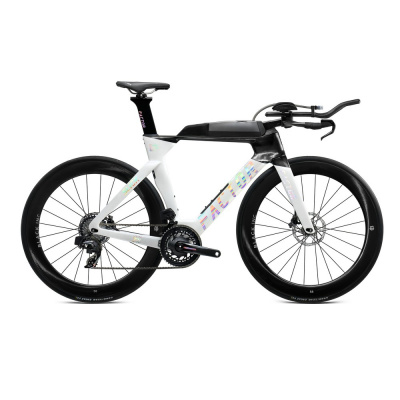
The range splits cleanly into two distinct machines. The Hanzo is Factor's pure time trial weapon, engineered to push UCI geometry regulations to their absolute limit for riders competing in everything from RTTC sporting events to elite-level racing. The Slick takes a different path - built around the demands of long-course triathlon, with non-UCI-compliant aero profiles, integrated hydration, and nutrition storage for riders who need to stay self-sufficient from T1 to T2.
Both bikes use radical front-end integration and proprietary carbon layups to chase drag coefficients that more conventional race bikes can't match. If you're hunting a personal best on an exposed A-road course or want to come off the bike leg fresh enough to actually run, Factor has built something worth your attention. Browse the current builds below, and if you're after a bespoke build, check out our Factor frames page to start from scratch.
Prices and availability can change quickly. Delivery charges are not always included in listed prices.
Final price, stock status and delivery terms are set by retailer. We may receive a commission on purchases made.
Decoding the Factor TT and Triathlon Lineup
Factor keeps the range focused, which makes choosing straightforward. The Hanzo is the time trial bike - fully UCI legal, designed to sit at the very edge of what the rulebook allows in terms of tube profiles and geometry. If you're racing domestic time trials, stage race prologues, or representing your club at a national championship, the Hanzo is the one. It's not designed to carry your gels or your hydration bladder. It's designed to go fast in a straight line for however long the course demands.
The Slick is a different conversation entirely. Triathlon imposes no UCI equipment restrictions on the bike leg, which gives Factor room to use more aggressive aero tube shapes and, crucially, to integrate storage properly. On-bike hydration, bento box nutrition, and aero-optimised front-end storage mean you're not stuck with a jersey pocket full of gels and a bottle between your arms that's hanging on by luck. For Ironman UK or a long-course event where self-sufficiency matters, that practicality is genuinely meaningful - not a marketing checkbox.
If you're weighing up Factor against other specialist manufacturers, Cervélo's TT and triathlon range and Argon 18's lineup are the natural comparisons, each with their own aerodynamic philosophy and geometry priorities. Factor's answer tends to be more radical at the front end - which is where it gets interesting.
The Factor Tech Philosophy: Aerodynamics Meets Integration
The Hanzo's defining feature is its radical front-end integration. The fork doesn't simply plug into the headtube in the conventional sense - it extends through it, creating a seamlessly blended, ultra-narrow profile that dramatically reduces the frontal area where drag is most punishing. It's the kind of detail that looks almost wrong until you understand what it's doing aerodynamically. Wind-tunnel tested and refined, this one-piece fork and headtube design is the centrepiece of everything Factor has done with the Hanzo.
The frame itself uses TeXtreme carbon fibre combined with a Pitch fibre layup - two materials chosen for their stiffness-to-weight ratio rather than cost efficiency. TeXtreme's spread-tow construction reduces resin content and saves weight without sacrificing rigidity, while Pitch carbon (an ultra-high-modulus fibre) handles the bottom bracket area specifically, keeping power transfer direct and loss-free when you're grinding out the watts on a flat A-road course. Stiff where it needs to be. Not brutally heavy. That's the balance.
Cockpit integration is handled through Factor's partnership with Black Inc, whose aero extensions and integrated cockpit systems are built to work with the Hanzo's geometry rather than being bolted on as an afterthought. The adjustability matters - TT position is personal, and a cockpit that can be dialled in precisely is worth more than one that looks aero in a catalogue but forces compromises in the real world. If you're comparing against BMC's time machine lineup, which takes a similarly integrated approach, the Black Inc partnership gives Factor a distinct advantage in terms of component quality at the front end.
The wide-stance fork design also deserves a mention separately from its integration role. Beyond the aerodynamic gains, a wider fork base improves tyre clearance and, more practically, contributes to stability in lateral airflow - which matters more than it might seem when you're deep in the aerobars and not actively steering.
Living with a Factor TT Bike in the UK
Here's what nobody mentions in the spec sheets: UK time trial courses are often brutal in ways that have nothing to do with gradient. Exposed dual-carriageway courses - common in the East Midlands and across Lincolnshire and Yorkshire - throw crosswinds at you early in the morning when conditions are at their least predictable. The Hanzo's wide-stance fork design helps here. More stability under lateral load means you're not fighting the bike when you should be focusing on your effort, and that's a genuine benefit on open, exposed courses rather than a theoretical wind-tunnel advantage.
Vibration damping is the other UK-specific reality. Factor's carbon layup does absorb some road buzz, but the Hanzo is still a stiff, purposeful machine. On rougher B-road tarmac - the kind you'll encounter at events like Ironman UK in Bolton - you'll feel the surface. That's not a flaw; it's the nature of a bike designed around aerodynamic efficiency rather than long-day comfort. Fit your tyre choice accordingly: a wider, supple 25c or 28c on the Slick will smooth things out more than you'd expect without meaningfully hurting your drag numbers.
Integrated headsets and fully enclosed front-end systems do require attention after wet rides. Britain's climate isn't kind to sealed bearing systems that sit without maintenance, and Factor's radical front-end means any bearing service is more involved than it would be on a conventional frame. Get it looked at regularly, especially through winter if you're doing wet-weather training or indoor-to-outdoor transitions. Sizing is the other thing worth flagging early: aggressive TT geometry rewards a proper bike fit before you commit. If you haven't been fitted on a TT-specific rig, get that done first - it'll save you weeks of positional adjustment after the bike arrives.
Factor's road bike range shares some of the same carbon and integration philosophy if you're also looking for a training partner to complement a race-day TT machine. Worth a look if you want consistent handling feel across your stable.
Factor Time Trial & Triathlon Bikes FAQs
Is the Factor Hanzo UCI legal?
Yes. The Hanzo is fully UCI legal and designed to work right at the boundary of current geometry regulations - nothing left on the table. It's the choice for competitive time trialists racing under UCI rules, from domestic club events through to professional stage racing.
What is the difference between the Factor Hanzo and Factor Slick?
The Hanzo is a UCI-legal time trial bike focused purely on aerodynamic efficiency within the rulebook. The Slick is built for triathlon, where UCI equipment rules don't apply - it uses more aggressive aero tube profiles and adds integrated hydration and nutrition storage for long-course self-sufficiency. Different tools for different races.
Are Factor bikes good for triathlons?
The Slick is built specifically for long-course triathlon. It combines serious aerodynamic performance with practical on-bike storage for fuel and hydration, which matters enormously over 180km. If your priority is the bike leg of an Ironman or 70.3, it's a considered, purpose-built option rather than an adapted road bike.